
Learning Forward
Equity and excellence in teaching and learning.

FOCUS
Leadership development that lasts
By Suzanne Bouffard
Categories: Career pathways, Implementation, Leadership, Research, School leadershipAugust 2025

Developing school leaders’ skills to ensure high-quality instruction in every classroom and high achievement for every student doesn’t happen overnight. It takes time, intentionality, and a cohesive set of supports that are often referred to as a principal pipeline. Research shows that when all the pieces are in place, principal pipelines can lead to significant gains in student reading and math achievement (Gates et al., 2019).
To have maximum impact, principal pipelines and other leadership development efforts need to be sustained over time so they can continue developing future generations of great school leaders. But with educational policies, funding, and workforces uncertain right now, how can states and districts ensure the longevity and consistency of effective pipelines for principals and other school leaders?
Researchers from Vanderbilt University and Policy Studies Associates (Goldring et al., 2025) recently took up this question. They dug into the sustainability strategies of districts that were part of the Principal Pipeline Learning Community, a group of 84 school systems that received capacity-building support from The Wallace Foundation over a four-year period from 2019-2023. (The districts did not receive dedicated financial support.) The researchers also conducted more in-depth case study analyses of four districts and reviewed previous research on sustainability in education systems.
The researchers’ major findings were that sustainability should be built from the beginning and throughout the development of principal pipelines and be anchored in four sustainability pillars. Their report articulates specific actions that districts can take to cement those pillars, provides examples from participating districts, and offers a concise set of recommendations for districts considering principal pipelines or other long-term professional learning strategies.
Although the report focused on efforts to develop principals and assistant principals, the concepts and themes can be applied to other forms of professional learning and other educational initiatives. The elements of the framework and the recommendations for implementation are consistent with Learning Forward’s professional learning work across a range of contexts and audiences, underscoring that leadership development relies on high-quality professional learning and vice versa.
A forward view of implementation
There are many ways to define and conceptualize sustainability. The Vanderbilt and Policy Studies Associates team defined it as “a forward view of implementation that, early in the development of new initiatives … considers how change can be embedded in a district’s ongoing work and culture, leading to lasting benefits” (Goldring et al., 2025, p. 4). They pointed to the need for transformation of daily practices, ongoing review and feedback, and adaptability characterized by “flexible design thinking rather than a static model of fidelity of implementation” (p. 5). This approach, which allows for and encourages evolution over time, accommodates education’s constant changes and fluctuations.
This definition of sustainability is consistent with the Implementation standard of Learning Forward’s (2025) Standards for Professional Learning. The Implementation standard explains that high-quality professional learning should be sustained over the long term through processes of change management, feedback, and intentional and sequenced implementation. One of the goals of the Implementation standard — and the standards as a whole — is to discourage the use of sit-and-get workshops or one-and-done learning sessions. Implementing with sustainability in mind includes both sustaining learning for one cohort of emerging leaders and securing the long-term future of leadership development.
The framework
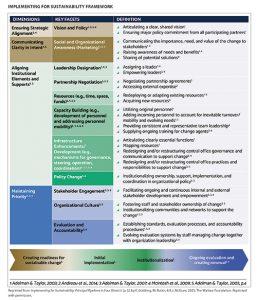
A framework isn’t just a thought exercise — it’s a tool that provides guidance and anchor points for, in this case, districts aiming to bolster and institutionalize their work. The Vanderbilt and Policy Studies Associates researchers provided a framework that was grounded in one developed by Adelman and Taylor (2003) and adapted based on the team’s observations and findings about principal pipeline communities.
The framework includes four pillars for sustainability:
- Ensuring strategic alignment through a clearly articulated vision and major policy commitment from all partners
- Communicating clarity in intent including clear messaging about the need for, value of, and intended outcomes of the leadership development initiative
- Aligning institutional elements and supports such as dedicated leaders, resources, infrastructure, personnel, and policies
- Maintaining priority through stakeholder engagement, organizational culture, and evaluation and accountability
The specific components of each pillar are presented in more detail in the table on page 27. The elements of the framework will be familiar to educators who use the Standards for Professional Learning, because quality and sustainability go hand-in-hand — you can’t have one without the other.
Because different pillars and components are more prominent at certain stages of implementation, the figure is color coded according to four phases of sustainability (Adelman & Taylor, 2003): creating readiness for sustainable change, initial implementation, institutionalization, and ongoing evolution and creative renewal. The transition from one phase to another is gradual and flexible, so some pillars remain consistent across more than one phase.
As professional learning leaders know, reflection and feedback are essential for improvement. Just as they are built into the development of new ideas, for example through continuous improvement cycles, they are also essential for long-term sustainability. While moving through the phases of sustainability, initiative leaders may need to revisit and strengthen early components of the process, and even in the earliest stages of the process they should have the end phase and its components in mind.
Keys to success
What does it take to put the pillars into place in school districts? Although many aspects of the sustainability framework are applicable across a wide range of fields from business to healthcare, there are some strategies that are specific to, or particularly important for, schools.
Based on their study of the principal pipeline districts, and especially the four case study districts of the Newark Board of Education (New Jersey), Greenville County Schools (South Carolina), the School District of Philadelphia (Pennsylvania), and Cumberland County Schools (North Carolina), the researchers made the following recommendations, which align with our own professional learning efforts.
A vocal champion who communicates the vision for leadership pipelines: All four districts have a high-level leader who is deeply committed to the principal pipeline and to messaging its importance. For example, the superintendent in Newark is a vocal supporter of the district’s pipeline, frequently raising awareness among district leaders and staff and cultivating buy-in not just within the district but among community members.
In our work with districts, we see the role high-level leaders play in setting the tone and modeling professional learning initiatives of all types. For example, in districts where superintendents are active participants in professional learning, they build buy-in and model best learning practices for other staff.
A pipeline leader who acts as the “hub”: While a high-level district leader establishes the district’s commitment, administrators at that level usually have too many responsibilities to oversee and coordinate all the details of the pipeline. Successful districts also have another administrator, typically within the central office structure, who has clear responsibility and authority for the pipeline and ensures coordination across offices and departments.
For example, in Philadelphia, the principal pipeline is housed in the Office of Leadership Development and overseen by the district’s chief learning officer, who was initially the deputy chief of leadership. Positioning the chief as the head of the pipeline initiative ensures there is a high-level authority who provides both vision and accountability. The director is responsible for the pipeline strategy and specific activities and for maintaining and regularly revisiting the district’s Leadership Pathways Framework.
We often see the benefits of this approach in other professional learning initiatives as well, which is why we recommend that major initiatives have a dedicated champion, such as a mentor champion who keeps their eye on the ball of the district’s new-teacher mentoring program. Although the champion may have other roles as well, they are expected to serve as the initiative’s point person, organizer, and consistent face of the work.
Beyond an individual district, we find this hub approach can work across districts. We serve as the convener and facilitator of many learning networks that bring together districts with common goals but unique challenges and strategies. Our role as a hub is not to direct the districts’ efforts but to facilitate communication and collaboration, much as the within-district hubs in the principal pipeline districts help to ensure true collaboration and input across different departments and entities.
Central office coordination to foster collaboration: In the case study districts, central office staff intentionally break down silos across departments, for example by facilitating collaboration among human resources, professional development, and operations. In addition to communication, this involves revising job descriptions, readjusting caseloads, providing resources, and aligning tasks.
For example, Greenville strengthened its central office infrastructure to coordinate all aspects of the principal pipeline. The director of staff and leadership development coordinates internal and external partnerships and facilitates communication. Central office staff coordinates across departments to implement distinct components and programs within the leadership pipeline. And central office leaders restructured practices and responsibilities to align with pipeline needs and goals, including reducing principal supervisors’ caseloads.
The value of the central office and its leaders is captured in the Standards for Professional Learning’s Leadership standard. While central office leaders are certainly not the only leaders who need to be involved in high-quality professional learning, they play an essential role in all aspects of the standard, but especially sustaining coherent support to build educators’ capacity.
Evaluation metrics that align to district strategic goals and planning: Thoughtful evaluation provides pipeline districts with data to reflect on and improve their efforts, demonstrate progress and return on investment, and reinforce commitment and buy-in. Case study districts use a range of evaluation data, some of which were designed for the initiative and others that already existed. Data sources include personnel tracking systems, placement and retention data, and stakeholders’ perceptions gathered through focus groups and interviews.
For example, the team in Cumberland County establishes evaluation metrics that align with their goals, such as principal retention and the number of principals who have three or more years of experience. Just as importantly, this information is shared regularly with the district cabinet and the school board so that all key stakeholders can monitor progress and make adjustments to the strategic plan as needed.
Click the below pdf for a larger version of the table.
In similar fashion, for all Learning Forward networks, we encourage our district partners to identify metrics aligned to goals, continually monitor, and adjust as necessary. For example, in our current Curriculum-Based Professional Learning Network, district staff in Montgomery County, Maryland, compared data for students whose teachers did and did not participate in a deep dive into how to apply the Illustrative Mathematics curriculum (Foster, 2024). They looked at district-administered standardized tests, end-of-unit assessments from the curriculum, and behaviors such as how frequently and comfortably students talked about math concepts. Students in participating teachers’ classes improved their proficiency scores on district tests from an average of 9% to an average of 52% over just one marking period. Some of the most vulnerable students outperformed the district average on curriculum assessments by up to 20% and showed increased confidence using mathematical vocabulary.
Flexibility and feasibility
Although many of the core principles are common across principal pipeline districts, each of the four case study districts has taken a unique approach to implementing them and building a sustainable pipeline. That responsiveness to local context is a key element for success. It is also a hopeful sign about the feasibility and potential long-term existence of principal pipelines that support current and future school leaders in providing the direction and support that teachers and, most importantly, students need.
Download pdf here.
References
Adelman, H.S. & Taylor, L. (2003). On sustainability of project innovations as systemic change. Journal of Educational and Psychological Consultation, 14(1), 1-25. tinyurl.com/mrurfxbz
Foster, E. (2024). Maryland students make math gains, powered by educator professional learning. Learning Forward. tinyurl.com/yeanxp23
Gates, S.M., Baird, M.D., Master, B.K., & Chavez-Herrerias, E.R. (2019). Principal pipelines: A feasible, affordable, and effective way for districts to improve schools. RAND. tinyurl.com/42b2c89k
Goldring, E., Rubin, M., & McGraw, K.J. (2025). Implementing for sustainability: Principal pipelines in four districts. The Wallace Foundation. tinyurl.com/3u855hrp

Suzanne Bouffard is senior vice president of communications and publications at Learning Forward. She is the editor of The Learning Professional, Learning Forward’s flagship publication. She also contributes to the Learning Forward blog and webinars. With a background in child development, she has a passion for making research and best practices accessible to educators, policymakers, and families. She has written for many national publications including The New York Times and the Atlantic, and previously worked as a writer and researcher at the Harvard Graduate School of Education. She has a Ph.D. in developmental psychology from Duke University and a B.A. from Wesleyan University. She loves working with authors to help them develop their ideas and voices for publication.
Categories: Career pathways, Implementation, Leadership, Research, School leadership



CURRENT ISSUE
Recent Issues

LEARNING WITH AI
February 2026
Generative AI can be a powerful tool for professional learning design and...
WHAT STUDENTS NEED NOW
December 2025
For all students to thrive, we need to understand who they are and what...
LEARNING COMMUNITIES FOR LEADERS
October 2025
Leaders need opportunities to connect, learn, and grow with peers just as...
MAXIMIZING RESOURCES
August 2025
This issue offers advice about making the most of professional learning...