
Learning Forward
Equity and excellence in teaching and learning.


Principals are responsible for ensuring the success of every student in their schools, regardless of background, family circumstances, or prior academic performance. Commitment to that vision is just the beginning of principals’ path to success for all. The knowledge, attitudes, skills, and practices principals need to lead in the service of all students are multifaceted and interconnected. They aren’t all innate and they don’t develop overnight.
A substantial body of research commissioned by The Wallace Foundation shows that well-designed principal pipelines can produce leaders who improve success of schools and, ultimately, students. More than a decade of research outlines seven key domains of effective principal pipelines that are represented in the figure below: leader standards, preservice leader preparation, leader hiring and placement, on-the-job leader support, principal supervision, leader tracking systems, and sustaining systems (Gates et al., 2019).
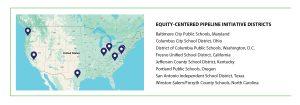
To further illuminate how principal pipelines can benefit every child, especially those who have been historically marginalized or furthest from opportunity, Wallace founded the Equity-Centered Pipeline Initiative (ECPI) in 2021. The six-year initiative supports eight urban districts to build comprehensive, aligned principal pipelines that develop school leaders who can advance each district’s vision of learning for all.
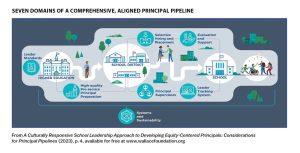
Each district responds to its own local context and vision and develops its own system for principal development, but draws on the seven pipeline domains. Each collaborates with their state education agency, local higher education institutions, and community-based organizations.
The first synthesis of key themes from the initiative was published in January 2026, led by Comprehensive Assessment of Leadership for Learning/Equity Centered Leadership (CALL-ECL) at the University of Wisconsin-Madison, in collaboration with the Annenberg Institute for School Reform at Brown University, American Institutes for Research, and the School of Education and Information Studies at the University of California-Los Angeles (Molle et al., 2026).
Based on more than 400 meetings and 245 interviews and focus groups with district representatives and their partners, the researchers identified key challenges and solutions the districts reported over the first four years of the initiative. They identified six promising practices, each of which addresses a challenge encountered by one or more districts and could be applied by districts and education systems beyond the initiative.
All six promising practices embody aspects of high-quality professional learning. Together, they underscore the need for sustained and systemic principal development and serve as a reminder of why one-and-done training sessions are not effective for making meaningful changes in leadership and student outcomes.
Standards for Professional Learning
Learning Forward (2025) created the Standards for Professional Learning to describe the conditions, content, and processes for high-quality professional learning for all educators. Together, the 11 standards articulate a vision for and specific steps to meaningful and ongoing professional growth for teachers, coaches, school leaders, district leaders, and everyone who works in educational systems.
As an important form of professional learning in itself and also a process essential to creating the conditions for other educators’ learning and growth, leadership development should align with the standards. When implemented well, the seven principal pipeline domains are consistent with the standards, as in the ECPI.
Districts in the initiative embody the standards in multiple ways that include but go beyond the Leadership standard, as evident in the six promising practices identified in the recent report. In the following section, the standards noted for each promising practice are not intended to be a comprehensive list. Rather, the goal is to show examples of how principles of learning for all, leadership best practices, and high-quality professional learning characteristics are integrally connected.
Promising practice #1: Developing a principal residency program
Many aspects of leadership development happen on the job, even when leaders have a strong foundation from a preparation program. Yet many school leaders are thrown into the role with little support or mentoring. This can cause problems not only for strategy development and operational functions, but for the enactment of beliefs and principles core to the mission of the district.
To support early-career leaders in developing and living out a commitment to equity-centered leadership, Baltimore City Public Schools in Maryland developed a 12-month residency program called iLEAD (Intensive Leadership Education and Development) for selected principal candidates. Grounded in the district’s leadership framework and principles of equity, it provides job-embedded leadership development, monthly professional learning seminars, and on-demand coaching with an experienced principal mentor.
Aspiring principals learn about applying instructional leadership practices that drive student achievement, leading high-performing teams, building strong school communities through systems and structures, and using protocols and processes to drive continuous school improvement. After the 12-month program, participants commit to leading one of the district’s schools for at least one year.
The program, which serves up to 10 aspiring leaders a year, is popular and selective. In 2024-25 there were 33 applicants, of whom five were selected; in 2025-26, there were 58 applicants, 10 of whom were selected. Nearly all of the initial participants have gone on to serve as principals or assistant principals.
Standards reflected:
- Professional Expertise: iLEAD fills a gap in leadership knowledge and experience by fostering expertise essential to participants’ new and emerging roles, aligning with the need for specialized learning when educators shift positions.
- Learning Designs: The program utilizes evidence-based designs such as expert coaching and mentoring to support the transfer of learning to practice over time.
Promising practice #2: Expanding university partners beyond preparation. Universities can be a source of support for professional learning in multiple ways. Increasingly, districts are building partnerships with local universities to tighten alignment between preparation programs for future teachers and future leaders. Although this is an important step, Columbus City Schools in Ohio wanted to go further and leverage university expertise for ongoing professional learning for its principals.
After identifying a professional learning gap for middle school principals, the district worked with The Ohio State University to offer professional growth opportunities for all middle school leaders. The result was a series of professional learning sessions that built on the university’s expertise and field leadership in equity, incorporating a framework for culturally responsive school leadership. Principals had opportunities to explore equity issues relevant to their specific schools, participate in an annual Leadership for Equity Institute, engage in regionally focused learning journeys on specific topics, and regularly share their insights with other principals.
The partnership has significantly expanded middle school principals’ access to professional growth opportunities, especially for veteran principals with more than three years of experience, who previously had few such opportunities. Participation in the leadership institute has grown exponentially, from 30 to 320 leaders over a four-year period, and over 70% of participants report that it is applicable and relevant to their work.
Standards reflected:
- Resources: Partnerships with local universities allow the district to leverage external resources (financial, human, and intellectual) to achieve specific goals aligned with system priorities.
- Curriculum, Assessment, and Instruction: The university and district’s partnership is consistently focused on student needs and outcomes and is aligned with the district’s portrait of a graduate. District and school leaders are motivated by Wallace-supported research showing the connection among school leaders, high-quality instruction, and student achievement.
Promising practice #3: Engaging the community in principal selection. Family and community engagement in selecting school leaders isn’t just a nice to have; it’s an equity issue. Community input in hiring is associated with leaders fostering more inclusive school cultures and committing to ongoing family and community engagement. Such input is not the norm in many places, but a promising exception is in District of Columbia Public Schools in Washington, D.C.
The district has a history of including a panel of community members in the principal hiring process. The panel includes 9 to 12 community members (parents, students, and others) who are identified by the larger community and who meet with principal candidates. They pose questions that align with the district’s leadership framework and with submissions from the community, then facilitate a discussion and share feedback with district leaders.
Through ECPI, the district has built on and deepened that process, increasing leaders’ involvement and facilitating connections with its Community Action Team and School Leader Recruitment and Selection Team. As the researchers write, “The community panel process, therefore, is a valuable opportunity not only for the community to provide input but for district leaders to engage with the community and with colleagues across departments.” The district is now using this process as a model to revise the hiring process for assistant principals.
Standards reflected:
- Learning Drivers: By collaborating with diverse stakeholders who hold varying perspectives, the district ensures decision-making reflects the diversity of the community and is not limited by a single vantage point.
- Learning Practices: Fostering relationships with families and communities both communicates that school leaders trust and value those stakeholders’ expertise and also provides a valuable source of information for school leaders to learn from all families’ experiences and wisdom. This helps create more responsive school environments.
Promising practice #4: Establishing leadership affinity groups. Across the U.S., it is unfortunately not common for the backgrounds of staff and leaders to reflect those of students. Many districts are aiming to change this pattern, based on research showing students of color are more successful when exposed to educators who share their background characteristics. Fresno Unified School District in California is one such district.
One of the district’s strategies for attracting, supporting, and retaining leaders of color is the creation of affinity networks. These networks provide both formal and informal opportunities for district and school leaders of color to connect, learn together, and offer mutual support.
Fresno’s affinity groups are designed to include professional learning opportunities and mentoring from experienced leaders, provided in partnership with the organization Men of Color in Educational Leadership. To ensure the affinity groups are places for powerful and sustained learning, the district has dedicated time and resources to structuring the groups, including the involvement of principal supervisors and the human resources department.
District leaders believe the affinity groups are partially responsible for a positive trend toward higher recruitment and retention of leaders of color. For example, the number of principals of color increased from 141 in 2023-24 to 150 in 2024-25. Positive feedback has also led the district to expand the affinity group structure to other leaders beyond principals and assistant principals.
Standards reflected:
- Culture of Collaborative Inquiry: Affinity groups provide a safe and supportive space for leaders to connect and collaborate on a regular basis and engage in meaningful conversations leading to continuous improvement.
- Learning Foundations: The groups provide a sustained structure that ensures access to ongoing learning for traditionally underrepresented staff. They also foster a culture that emphasizes respect for these staff members and their voices and expertise.
Promising practice #5: Focusing principal supervisors on equity leadership. Principal supervisors are an essential but often overlooked element of achieving leadership goals. Recognizing their importance for equity-focused leadership and systems change, Portland Public Schools in Oregon reshaped its principal supervision system and resources to align with and reinforce the district’s equity vision.
Key parts of this effort include a new leadership coaching framework and observation and evaluation rubrics. The rubrics detail what equity-centered leadership looks like in practice and spell out specific steps for getting from an emerging level of implementation to a transformative level. Designed for discussion, exploration, and reflection, they build principal supervisors’ understanding so they can in turn develop principals’ understanding and practice. They also provide a way to document growth over time. The framework and rubrics were designed collaboratively and with input from local and national organizations and stakeholders. The process included a professional learning series about coaching stances and best practices, with opportunities for participants to practice and refine their coaching skills.
The framework and coaching rubrics are now built into the district’s observation and evaluation processes for consistency. The district has also shared them with local university partners to foster coherence between leader preparation and internship experiences and district expectations and processes.
Standards reflected:
- Implementation: Coaching protocols and observation rubrics provide practical structures to ensure real and ongoing application of equity-focused principles.
- Evidence: Using the structured rubrics, principal supervisors can document principals’ equity-centered practices at a moment in time and over time. This information can be used to identify needed growth areas and support types.
Promising practice #6: Sustaining equity-centered leadership work. Sustainability is an ever-present challenge for change initiatives, especially in educational contexts, which are fast-moving and multifaceted. It is also a core value of the ECPI project. Intentional structures are a key part of that commitment. ECPI districts aim for long-term sustainability in multiple ways, including district policies, strategic plans, and cross-departmental structures.
Jefferson County Public Schools in Kentucky built on a successful racial equity policy instituted in 2018 with a leadership development policy in 2024, which established a district leadership development program called the Jefferson County Leadership Academy.
The San Antonio Independent School District in Texas created a leadership definition aligned with the district’s student-focused strategic plan, Always Learning, and aligned resources such as an administrator coaching handbook.
Winston-Salem/Forsyth County Schools in North Carolina leverages the superintendent’s cabinet to create long-term, cross-district commitment to equity-centered leadership. Cabinet members identified relevant senior district leadership roles including the chief equity officer, chief academic officer, and principal supervisors, among others, who meet regularly with the leadership of the superintendent. They also created the Department of Talent Development and School Transformation led by the chief of schools to oversee professional learning for leaders as well as teachers.
Standards reflected:
- Leadership: These structures establish a clear vision and expectations for all students’ learning and for professional learning that centers it. They also create a solid foundation of responsibility by including expectations for the participation of multiple leaders and levels.
- Learning Foundations: The districtwide and long-term nature of these sustainability structures fosters diverse leadership across the districts and across a wide variety of roles. They establish expectations and support for all staff.
Multiple entry points
The ECPI districts’ promising practices do not function in isolation. They are part of broader systems of leadership development in their districts, all of which are grounded in the seven domains of high-quality principal pipelines. Similarly, the Standards for Professional Learning work together as a set and are not effective as one-off strategies. However, both the principal pipelines and the standards have multiple entry points. The examples shared here can serve as inspiration for districts and schools at any point in their journey to ensuring learning for all.
References
Gates, S.M., Baird, M.D., Master, B.K., & Chavez-Herrerias, E.R. (2019). Principal pipelines: A feasible, affordable, and effective way for districts to improve schools. RAND. learnfwd.org/1eaee4
Learning Forward (2025). Standards for Professional Learning.
Molle, D., Halverson, R., Mason, D., Diamond, J.B., Gomez, L.M., & Jones, W. (2026). Promising practices for the design and implementation of equity-centered leader pathways. University of Wisconsin-Madison. learnfwd.org/c80c2e

Suzanne Bouffard is senior vice president of communications and publications at Learning Forward. She is the editor of The Learning Professional, Learning Forward’s flagship publication. She also contributes to the Learning Forward blog and webinars. With a background in child development, she has a passion for making research and best practices accessible to educators, policymakers, and families. She has written for many national publications including The New York Times and the Atlantic, and previously worked as a writer and researcher at the Harvard Graduate School of Education. She has a Ph.D. in developmental psychology from Duke University and a B.A. from Wesleyan University. She loves working with authors to help them develop their ideas and voices for publication.



CURRENT ISSUE

Recent Issues

LEARNING WITH AI
February 2026
Generative AI can be a powerful tool for professional learning design and...

WHAT STUDENTS NEED NOW
December 2025
For all students to thrive, we need to understand who they are and what...

LEARNING COMMUNITIES FOR LEADERS
October 2025
Leaders need opportunities to connect, learn, and grow with peers just as...

MAXIMIZING RESOURCES
August 2025
This issue offers advice about making the most of professional learning...