
Learning Forward
Equity and excellence in teaching and learning.

IDEAS
Reimagining learning experiences with AI
By Suzanne Bouffard
Categories: TechnologyOctober 2025

Dyane Smokorowski is the coordinator of digital literacy and Rob Dickson is chief information officer for Wichita Public Schools in Kansas. They are national leaders in designing classroom experiences grounded in strong pedagogy and purposeful technology integration. They will build on their highly rated professional learning about AI in a keynote address at the Learning Forward Annual Conference on December 10, 2025, in Boston, Massachusetts.
Smokorowski was named the 2013 Kansas Teacher of the Year and inducted into the National Teachers Hall of Fame in 2019. Dickson is a 2021 Kansas City CIO of the Year (Public Sector) and has propelled Wichita to national recognition including Microsoft Showcase School honors. Smokorowski and Dickson are also founders of the Education Imagine Academy, a thriving K-12 virtual school.
In your district you use AI in multiple ways. One of the strategies you talk about is using AI as a thought partner. What does that mean and how does it look in practice?
Dyane Smokorowski: The wheels in my brain are turning all the time with new ideas and possibilities, but there are times when I need to bounce ideas around with someone else. The education profession can be very isolating, especially for teachers. If a teacher is lucky they might have a shared  planning time or a colleague to talk to at lunch, but with AI they have a perfect thought partner around all the time to test ideas and flesh out thinking.
Lately, my go-to strategy has been turning on dictation mode and simply thinking out loud and brainstorming. Afterward, I ask the AI to summarize my thoughts and help me think through what my next steps should be. From there I ask for three or four specific ideas to go along with those next steps. Even when I’m traveling, I’ll dialogue with ChatGPT for a couple of hours. This allows me to take my raw ideas and shape them to something that is more refined.
What are some of the other uses and benefits you see in your district?
Rob Dickson: When we interviewed teachers at one of our middle schools that was implementing a new magnet model, we learned that less than half  the teachers knew how to teach environmental science, which was the theme of the school. And so our research and intelligence department created a chatbot that would both help teachers who didn’t know much about environmental science learn about it and also help them learn how to teach it within their core classes. Using AI is probably the first opportunity many teachers have had to be both a learner and a facilitator at the same time. That’s a unique opportunity, and it’s a human-centered approach that is basically generated at will.
Smokorowski: I also use this process to help me design the best possible learning experiences for students and educators. For example, AI helps me design learning scaffolds. Just as in schools everywhere, we have students with learning exceptionalities such as ADHD, and visual cues can be especially helpful for them. I use tools like Ideogram to create graphics to go along with the instructions and thinking prompts.
Today I was working with students on an animal research project. I knew what I wanted them to come up with, but I also know students need thinking scaffolds to help their minds move from here to there. So I used AI and asked it to build something for me, and then I went back and forth with it for 16 versions until I had a visually driven thinking scaffold. The activity I created went off without a hitch in the classroom, because I had everything lined up for them so they could unpack their thinking and guide their research with choice and agency.
It’s important to point out that I’m not lesson planning with AI. I am designing learning experiences, which is a very different approach. I need my students to experience communication, collaboration, and critical thinking. I can’t always design that easily or efficiently by myself, and sometimes I need a different lens to look through. With AI I can consider additional questions, such as, “How will a student with an IEP likely respond to this classroom activity?” and “How can I design this lesson to help students who are struggling while meeting the needs of those who have mastered that skill?”
You’re getting at differentiation as a benefit of AI. Often when people talk about differentiation, they mean students using a computer program that adapts the difficulty of the problem or question according to students’ performance. But what you’re talking about is something fundamentally different.
Smokorowski: Yes. I’ll give you another example. I have been working at our vertical school, which is a K-6 school with mixed age classes, and I’ve been working with grades 4, 5, and 6 all in the same room. We are reading the novel Because of Winn Dixie together, but the students have different levels of thinking and critical analysis they need to meet. The grade-level standards all have students wrestle with character analysis but with a slightly different lens at each grade. So I approached the learning experience like a Swiss Army knife — it’s one solid tool but it pivots in different directions for different needs.
I worked with AI to say, “This is the learning experience I’m starting with, and these are the three different grade levels and lenses I need to address. How do I create an experience for the students based on the growth and developmental stages they are in?”
Using the suggestions I received and iterating on them, I developed a learning experience where the 4th graders identify the beginning, middle, and end of the story, while 6th graders provide evidence from the text to show how the character is coming of age. Each student had agency to create a visual representation of the concepts, such as making a sculpture or writing their own podcast interview. The scaffolds for that activity were differentiated for their grade and individual needs. Because the activity is designed to meet those needs, I am able to assess their end products more effectively.
The process you’re describing sounds very different from the way I hear a lot of people talk about AI — as a tool for efficiency and speed. What you’re describing sounds like it takes a lot of time and thought. How do teachers react to your approach?
Dickson: It depends on their exposure to AI up to that moment. Many times teachers have created a lesson using AI, but they haven’t gone to the level of depth we’re talking about, and that’s an issue that’s bigger than AI. Many teachers aren’t creating mechanisms in their workflow to go deeper into learning experiences, even when they are handed curricula and pacing guides and everything else the district does as a system. We educators don’t think enough about learning experiences. We want to help people ask themselves, “What could I do to build a better classroom experience, and how can artificial intelligence help me do that?” We want to help people get out of autopilot mode and open up to the possibilities.
Smokorowski: What we’re really teaching educators is how to shift practice. The goal is designing experiences where students have agency to meet the standards at a higher level. We do that through personalized learning, universal design for learning, and project-based learning. AI is a tool that helps us do that.
When we present it this way to teachers, they find it empowering. For example, during an AI professional learning experience I provide, I sometimes see teachers working on behavior management plans and feeling frustrated because they have done everything they can think of to help children who are struggling. I tell them they can explain the situation to AI — without any identifiable personal information — including what a child is struggling with and what motivates them and ask for strategies supported by peer-reviewed academic research that could help. When I mention this, I see a lightbulb go on for teachers and they say, “Wow. We can actually find the answers we need to help these children!” Then you start to see them asking, “Where has this been my whole life?”
When a person or a district has not gone down the road with AI yet, where would you tell them to start?
Dickson: First, on the IT side, you need to set up a practice of data privacy. You need to think about how to ask the right question or give the right prompt without divulging confidential information. This is important for everyone to do now, because AI as a feature is going to hit you faster than AI as a product. Just about every technology product out there, including Google search, has an AI feature or is going to have one soon.
Second, from a professional development standpoint, it’s important to define some of the technical elements for personalizing the tools. If somebody’s going to dip their toes in, they’re not going to get the same rich outcomes as a person who has worked with AI for a long time. It’s the same way relationships between people deepen over time, and you can have richer conversations with people you know well. So the more you can help people experiment with the tools, the better.
Smokorowski: If I were working with a district to roll out AI professional learning, I would start with principals. We decided to do a lot of one-on-one training with principals so they know how to support their teachers using AI in the classroom, and I think this was the best decision we ever made. In any initiative, teachers can’t be leaders if the administrators don’t understand and support them.
Then we do a series of professional learning experiences with teachers, usually in 30- to 40-minute increments. The first session focuses on prompt engineering to help teachers understand the need for specificity so they can start asking deeper questions. In the second session we focus on how to create images that build context and understanding for students who benefit from visual cues, which is most if not all kids.
In the third session we take a tour of different AI tools to see how they answer the same question differently and learn which tools are likely to give the best results for different needs. For example, I often start with ChatGPT to bounce an idea. Then when I have massaged my idea, I move the whole thing over into Claude and give a prompt to make it more kid-friendly and to sound more human. I use Perplexity to do academic research, for example saying, “Here are the animals the students have chosen for their research projects. Find kid-friendly websites that have the following parameters and don’t have ads.”
In the fourth session we work with school-specific tools such as SchoolAI. Teachers need to have experiences with chatbots before they let students try them out, so we guide them on how to use them and how to help kids use them.
Now we’re supporting teachers to roll out AI with students. We put in place some guidelines that apply to any AI tool. One of those is the need for teachers to see all communication that happens in the virtual space. SchoolAI is an example of a platform that does that. The teacher programs a chatbot specifically for the class and then can see everything that’s typed in and every response the chatbot is giving. The teacher also receives a report of how the interactions are happening, what misconceptions students are wrestling with, and more.
This way teachers can guide students to use the AI tools thoughtfully and responsibly. It’s like having a lead canoe out on a lake. As the teacher, I’m going to be the lead canoe and you, students, will go out with me, but I’m not sending you out on the lake by yourself until you have the skills to do this well.
We have put these pieces in place with all the teachers at Wichita North High School. We also rolled out Securly Classroom, which allows teachers to see every student’s device to monitor and even manage their tabs. When we put these pieces together, we can create really great things with students in the classroom. After teachers learn about all these tools and processes in professional learning they literally stand up, cheering and clapping.
What would you like people to know about the keynote session you’ll be doing at the Learning Forward Annual Conference?
Dickson: I encourage people to come with an open mind. I think everyone needs to have an awareness of AI and how education is going to change from the foundation we’ve relied on for such a long time. For example, we’ve always talked about removing rote memorization, but today the writing is on the wall that we really have to create different learning experiences. That’s necessary to help kids understand the world today, which is very different from the world we grew up in.
Smokorowski: Also, come ready to get applicable takeaways that you can use right when you go back to your schools or systems. We’ll share four plans of professional learning you can use. We’ll explain how AI can help with specific sticking points in education, like how to incorporate it with child study teams and behavior interventionists.
There are some things I can’t change in education. For example, I can’t add more time to the school day. But I can change how I work within those parameters and help other educators do that, using new tools. Our session is going to be fun, energetic, and exciting, and I’m confident you’ll walk away with ideas you can use immediately.
Download pdf here.

Suzanne Bouffard is senior vice president of communications and publications at Learning Forward. She is the editor of The Learning Professional, Learning Forward’s flagship publication. She also contributes to the Learning Forward blog and webinars. With a background in child development, she has a passion for making research and best practices accessible to educators, policymakers, and families. She has written for many national publications including The New York Times and the Atlantic, and previously worked as a writer and researcher at the Harvard Graduate School of Education. She has a Ph.D. in developmental psychology from Duke University and a B.A. from Wesleyan University. She loves working with authors to help them develop their ideas and voices for publication.
Categories: Technology


CURRENT ISSUE
Recent Issues
LEARNING WITH AI
February 2026
Generative AI can be a powerful tool for professional learning design and...
WHAT STUDENTS NEED NOW
December 2025
For all students to thrive, we need to understand who they are and what...
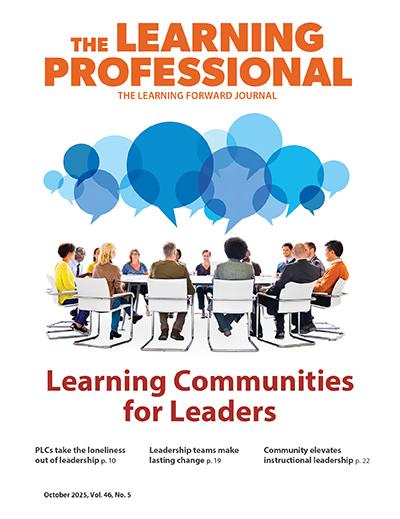
LEARNING COMMUNITIES FOR LEADERS
October 2025
Leaders need opportunities to connect, learn, and grow with peers just as...

MAXIMIZING RESOURCES
August 2025
This issue offers advice about making the most of professional learning...