
Learning Forward
Equity and excellence in teaching and learning.

THE WHOLE EDUCATOR
Is your view of well-being too narrow?
By Chris DeGuzman
Categories: Social & emotional learningOctober 2025

I used to treat my self-care practices like a to-do list. When I was a busy principal, putting appointments on my calendar and holding myself accountable was necessary to meet my teachers’ and students’ needs, so I got used to treating myself the same way. My workout times were scheduled and I did everything I could to stick to the plan. I set an alarm as a daily reminder to put my laptop away and go to bed. I packed foods that were easy to eat when I could squeeze in time between meetings, classroom observations, or whatever unexpected situations arose. Check, check, check!
As good as I was about maintaining foundational healthy habits, I was not well. I had to drag myself out of bed every morning. In moments alone, I’d find myself staring at the wall feeling numb inside. I had a slew of strange pains that doctors attributed to stress, despite the fact that I did not feel stressed. Looking back, I realize my self-care practices weren’t addressing what I really needed. They were based on culturally approved practices and a view of well-being that was too narrow.
Now as a health and wellness coach, I often work with people who experience the same struggle. When we take a more holistic view of what well-being means to them, we’re able to figure out how to realign their self-care practices to what will truly help them to feel well.
Of all the different models of well-being, I prefer to think about four broad categories: physical, mental, emotional, and spiritual well-being. The figure below shows multiple subdivisions within those categories to represent the complexity of well-being, but focusing on the four categories is helpful for understanding the big picture.
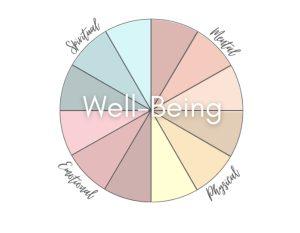
Four types of well-being
Physical well-being is the one that is most commonly valued, and there are systems all around us that reinforce that value. We have supportive structures like insurance plans that cover yearly physicals and checkups. Advertisements for gyms, yoga studios, and at-home exercise equipment creep into our social media feeds. More organic foods are showing up in grocery stores and more farmers markets are showing up in communities. The message is clear — your physical health matters.
Mental health comes in second as being a recognized aspect of well-being. Once a taboo topic, the rise in mental health crises has made it hard for anyone to ignore. And while mental health challenges aren’t as easy to spot as physical challenges, more organizations are integrating mental health supports with schools leading the way for children. What about the mental health of educators themselves? Do educators take in the lessons they learn about supporting students’ mental health and apply it to caring for their own? I like to hope that’s the case, especially since one study found that educators had higher rates of psychological stress than several other professions (Corbett et al., 2024).
Emotional well-being is often conflated with mental well-being. People often believe they should be able to think their way through unpleasant feelings. Taking a cognitive approach to your feelings can be helpful; for example, taking an honest assessment of stressful situations, using more positive self-talk, and having supportive people to help you process your experiences are all great for your mental health. However, too often people negate or suppress their emotions in the process. This lumping together of mental well-being with emotional well-being is one common reason I see people struggling to successfully improve their overall sense of well-being.
When I work with clients to explore the differences between mental well-being and emotional well-being, they come to a more nuanced understanding of themselves. Instead of shutting their emotions down and rationalizing their way through situations, they can learn from those emotions and approach situations in more compassionate ways. They also start to see emotions as a helpful signal to reset their nervous system and close out the stress cycle, rather than seeing them as an interference in their lives.
I find that spiritual well-being is often left out of educators’ well-being conversations because of a perception that it too closely resembles religion. While religious beliefs and practices can be an important aspect of a person’s spirituality, spirituality goes beyond your beliefs about a higher power. Spirituality is a fundamental aspect of the human experience. It encompasses a sense of wonder, a connection to something bigger than ourselves, and a belief in humanity, things that I would argue are central to an educator’s resilience, motivation, and work satisfaction.
Identify which elements of well-being are most important for you
How important is each of these aspects in your own sense of well-being? And could a shift in the care and attention you give to each empower you and realign your energy?
To help you explore this, try the self-assessment below. Start by rating each statement on a scale of 0 to 5, with 0 being not at all true for you and 5 being extremely true for you.
Physical well-being
- I fuel my body with nutritious food and water.
- I maintain a healthy balance between activity and rest.
- I spend time in a rejuvenating environment.
Mental well-being
- I see challenges as opportunities to grow.
- I speak to myself with compassion.
- I exercise my mind through curiosity and learning.
Emotional well-being
- I’m attuned to emotions, both my own and those of others.
- I regularly connect with supportive people who allow me to express my emotions.
- I’m able to experience emotions without allowing them to overwhelm me.
Spiritual well-being
- I feel connected to a sense of purpose.
- I believe I am an important part of something larger than myself.
- I experience moments of awe and inspiration.
What surprised you or moved you? How important is each element to you at this stage of your life?
If you’re satisfied with certain aspects, take a moment to celebrate. Acknowledging the time, effort, and energy you put into your self-care practices is good for your well-being.
For the areas that feel less satisfying, you get to decide what matters most right now. It’s not likely that each of the four types of well-being carries the same weight for you. By deciding which elements of well-being are most important for you right now, you can redirect your efforts in a way that aligns with your current needs. This doesn’t mean you have to scrap the healthy habits you’ve established or should ignore your health care provider’s advice. But you can make adjustments like going for a brisk walk in nature to support your physical and spiritual needs or planning regular get-togethers with someone who allows you to speak freely and brings you joy.
When you have a more holistic view of well-being, your self-care becomes less of a checklist of things to do and more of an aligned approach to life. And living in alignment is key to truly feeling well.
For more articles and resources, subscribe to my mailing list at tinyurl.com/2pnhhsde.
References
Corbett, L., Van Buskirk, J., Phongsavan, P., Bauman. A. (2024). A cross-sectional nationwide study of Australians’ health: Are there differences in health-related behaviors and psychological distress between teachers and other occupations? Journal of School Health, 94(10), 929-938.

Chris DeGuzman is a consulting partner with Learning Forward, adjunct professor and National Board Certified Health and Wellness Coach. As a former teacher and principal, Chris believes that schools cannot thrive without caring for their greatest assets - educators. Through her coaching practice, FreshLeap Coaching & Consulting, Chris supports educators and other professionals in creating balanced, healthy, and joyful lives.
Categories: Social & emotional learning

CURRENT ISSUE
Recent Issues
LEARNING WITH AI
February 2026
Generative AI can be a powerful tool for professional learning design and...
WHAT STUDENTS NEED NOW
December 2025
For all students to thrive, we need to understand who they are and what...
LEARNING COMMUNITIES FOR LEADERS
October 2025
Leaders need opportunities to connect, learn, and grow with peers just as...
MAXIMIZING RESOURCES
August 2025
This issue offers advice about making the most of professional learning...