
Learning Forward
Equity and excellence in teaching and learning.

IDEAS
Differentiation isn’t just for students
By Robyn Christensen, Jessica Navarro and Ebony Love
Categories: Personalization, ResourcesDecember 2025

Many veteran educators are familiar with this professional learning scenario: Teachers from all grades and subjects are gathered in the library or cafeteria working on a mission statement for the school year, reviewing referral protocols, or examining data from the previous year’s standardized tests. While these topics have their place, they do not address the potential personal growth each individual looks to experience with their own content and classroom environment. Teachers often find themselves thinking, “What does that have to do with my students?” or “How does this apply to my classroom?”
Why do our systems emphasize differentiation for students but not for teachers? Our kids come to us with different needs and prior knowledge. Isn’t the same true for teachers? Research shows that teachers tend to be more engaged in professional learning and more likely to implement what they learn when they have a choice in the content and focus (Bill & Melinda Gates Foundation, 2014; Kennedy, 2016; McCarthy & James, 2017; Mushayikwa & Lubben, 2009). Ownership over content allows teachers to address personalized areas for change and improvement, whether in classroom management support, instructional strategies, or specific classroom content.
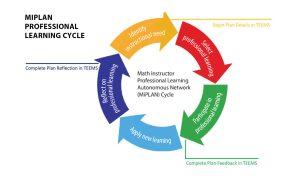
In 2021 the Texas Center for Educator Excellence (TxCEE), which is part of the state’s Region 18 Education Service Center, addressed the need for teacher choice in professional learning by creating the Math Instructor Professional Learning Autonomous Network (MiPLAN). This was a five-year project in which teachers chose from a library of vetted, high-quality professional learning opportunities, worked with in-person coaches from TxCEE, and embarked on a self-selected professional learning cycle. With funding from a federal Education Innovation and Research grant, we partnered with American Institutes for Research (AIR) to implement the project and conduct a randomized control trial with 24 schools, half of which participated in our program starting in Year 1 and half of which served as a control group by participating a year later.
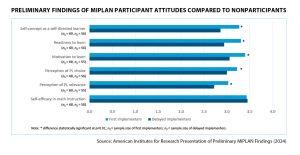
Preliminary findings suggest that participating teachers felt a stronger connection between professional learning and their classroom practice than did control group teachers. They also reported they were more motivated to attend and engage with professional learning.
Identifying needs and learning opportunities
At the heart of the project was the MiPLAN professional learning cycle, a set of steps teachers went through with a TxCEE coach. In the first step, each educator identified an aspect of classroom teaching they would like to explore. The process of choosing an area of focus varied from teacher to teacher, but all teachers were able to work with a TxCEE coach and consider factors such as student data, classroom behavior, and instructional needs. Since we started with math teachers, it was not surprising that many teachers chose to focus on learning innovative new approaches to math lessons. Teachers also looked to strengthen classroom management, better serve students with special needs, and explore educational technology.
Once teachers selected a focus area, they worked to identify a relevant professional learning opportunity. Opportunities included conferences, online courses, on-site coaching, and in-person workshops. Support available during the decision-making process included coaching and a professional learning library that our team compiled.
With a wide variety of topics and opportunities available in the field, it was important to have a system to assess quality and ensure teachers were engaging in worthwhile opportunities. We developed a rubric for assessing quality, aspects of which were based on Learning Forward’s (2025) Standards for Professional Learning. For example, we included a criterion for collaboration based on the Culture of Collaborative Inquiry standard. The explanation of that standard states, “When educators at every role, grade level, and content area collaborate for continuous improvement and support their colleagues’ ongoing learning and development, they increase learning opportunities for each student.” In our rubric, to qualify as adequate on the collaboration criterion the description of the professional learning needed to explain how teachers would collaborate as part of the learning experience.
Other criteria included sustainability, alignment to state standards for student learning, relevance, and time orientation (meaning the new learning is immediately actionable in the classroom). Together, the criteria ensured the professional learning would be timely and beneficial, ultimately contributing to student growth.
As we rated the opportunities found by TxCEE coaches and those teachers proposed, we built up a library of approved professional learning experiences. This growing library was housed in an online platform, the Texas Educator Excellence Management System (TEEMS). Through this system, teachers could see ratings on each of the rubric criteria and an overall opportunity score to help them select a learning opportunity. TEEMS also served as a way for our team of coaches and district leaders to track progress through the MiPLAN cycle and monitor patterns in teachers’ choices and experiences.
Documentation and reflection
After they selected and participated in professional learning, teachers immediately documented their participation and reflected on it in TEEMS. Over time, TxCEE compiled these teacher reflections to deepen our understanding of which professional learning experiences had the most impact, and we included that information on our website and in coaching conversations.
During the next part of the MiPLAN cycle teachers focused on implementing, ideally over a period of four to six weeks, what they had learned and completed an additional reflection form in TEEMS. This reflection process helped reinforce the learning teachers had gained and set up their next steps for continued growth. During this time, TxCEE coaches remained available for support. Some teachers took advantage of the coaching to talk through and plan implementation in the classroom and/or to navigate their use of TEEMS.
Outcomes for participating teachers
To test the impact of the project, 24 schools were randomized to either engage in the MiPLAN professional learning cycle in Year 1 or to serve as a control group that didn’t participate until Year 2. Each of the schools participating in the first year received funding for 104 teachers to attend professional learning of their choice. At the end of the year all the teachers, both those participating in the learning cycle and those in the control group, provided data through surveys, with some selected for interviews or classroom observations by video.
Teachers participating in MiPLAN reported both an increase in professional learning engagement and a positive perception of professional learning compared with teachers in the control group (Garrett et al., 2024). They also saw themselves more as self-directed learners and reported greater motivation and readiness to learn than did teachers who did not participate. In particular, teachers liked that MiPLAN allowed them to choose professional learning that was relevant, aligned to their individual teaching goals, and likely to make an immediate impact in their classrooms. (See the figure below for more detailed findings.)
One participant was Nivea Barboza, a math teacher at Fossil Hill Middle School in Fort Worth, Texas. She chose to attend an in-person conference run by Building Thinking Classrooms, which provides research-based instructional practices that specifically encourage problem-solving and deep thinking in the mathematics classroom. Among the components she incorporated into her own classroom were collaborative learning groups and sharing information on vertical nonpermanent surfaces like white boards, smart boards, or windows. She shared that her self-selected learning impacted her classroom and “changed the whole way in which students work and interact with each other.”
Barboza’s feedback reflects a common sentiment heard by TxCEE coaches when they visited MiPLAN participants in their schools: When teachers felt they had control over their professional growth, they reported more buy-in on new strategies and approaches. Administrators have also reported a difference in participating teachers’ attitudes. Travis Shera, an assistant principal at Fossil Hill, said “there was more excitement before and after” the professional learning for participants compared to past experiences and control group teachers. He saw that teachers were motivated to apply what they learned when they returned to the classroom, because they felt they had engaged in learning that would benefit their own professional practice. When teachers who participated in MiPLAN shared their thoughts with their TxCEE coaches on experiences they chose, they often had a sparkle in their eyes. They seemed to stand a little taller and feel a little more appreciated.
We also noticed that teachers demonstrated a strong sense of camaraderie after attending professional learning as a content or grade-level team. For example, educators at Jubilee Brownsville in south Texas chose to attend a conference in Las Vegas together. They have shared many stories filled with inspiration, new ideas, and connections. They met teachers from all over the country and beyond. One teacher, Joann Serrato, said, “The biggest impact in choosing my own [professional learning] was being able to relate with other teachers and share strategies and resources.”
Future considerations
MiPLAN concluded in the summer of 2025, and we can now reflect on the impact this program made on participating teachers and their students. MiPLAN has produced results we should consider when planning future professional learning protocols to ensure an engaging and sustainable approach, including the following.
- District and school commitment is key. Leaders can ensure teachers have sufficient time to engage with self-directed professional learning that meets their unique needs. For example, some districts provide opportunities for teachers to swap professional learning they take in summer with professional learning days during the following school year.
- Coordinating with district and school administrators before the project begins allows time to think through travel and purchasing policies. Making professional learning funds available for teachers up front makes professional learning more accessible.
- MiPLAN’s comprehensive list of vetted, high-quality opportunities allowed teachers to attend professional learning they otherwise might not have. Without the support provided in this program, teachers might not have had access to important and detailed information, because websites and program descriptions do not always have the necessary information to make an informed decision. Our program took on this time-consuming process of compiling quality professional learning, which helped teachers see and choose from quality options.
- TEEMS provided a clear and helpful way to collect and share information about professional learning opportunities. It is still available and is used by districts for other TxCEE projects. The MiPLAN interface was retained and could be used again for documentation, monitoring, and reflection.
These steps can help education leaders make high-quality, differentiated professional learning possible and practical for all teachers. The improved skills and increased enthusiasm seen in MiPLAN teachers shows that when we meet teachers’ specific needs, they can better meet students’ specific needs.
References
Bill & Melinda Gates Foundation. (2014). Teachers know best: Teachers’ views on professional development. tinyurl.com/bdds7nwb
Garrett, R., Píriz, D.G., Pardo, M., Altieri, A., Duran, A., Salvato, B., & Lin, S. (2024). What happens when teachers have a choice in their professional learning? Preliminary findings from a randomized field trial of the MiPLAN voucher program [Paper presentation]. Society for Research on Educational Effectiveness (SREE) 2024 Annual Conference, Baltimore, MD.
Kennedy, M.M. (2016). How does professional development improve teaching? Review of Educational Research, 86(4), 945-980.
Learning Forward. (2025). Standards for Professional Learning.
McCarthy, K.E. & James, W.B. (2017). Are teachers self-directed? An examination of teachers’ professional learning. International Journal of Self-Directed Learning, 14(1), 58-72.
Mushayikwa, E. & Lubben, F. (2009). Self-directed professional development — Hope for teachers working in deprived environments? Teaching and Teacher Education, 25(3), 375-382.
Robyn Christensen serves as an instructional and support specialist at the Texas Center for Educator Excellence (TxCEE) at Region 18. She provides training, coaching, strategies, and resources to teachers in districts across Texas. Before joining TxCEE Robyn worked with teachers in central Texas through certification work with Texas Teaching Fellows and through the REACH grant at Austin ISD’s Office of Educator Quality. She has 15 years of classroom experience teaching middle school math. Robyn graduated from the University of Texas at Austin with a Bachelor’s Degree in Social Work and earned a Master’s Degree in Educational Leadership from Concordia University.

Jessica Sievert Navarro, Ph.D. has over twenty years of experience working across national, state, and local public and nonprofit organizations. These opportunities allowed her to lead statewide initiatives, facilitate professional learning, administer large-scale grants, and engage partners in designing and implementing evidence-based practices. Dr. Navarro earned her Bachelor’s in International Studies, Master’s in Public Administration, and Doctorate in School Improvement, focused on educational and community leadership, from Texas State University.
Ebony Love is an assistant principal dedicated to fostering a culture of excellence and continuous growth for both students and teachers. She holds a Doctorate in Educational Leadership as well as a Master’s degree in Educational Leadership and Chemistry. Her work centers on instructional leadership, relationship-building, and creating learning environments where all stakeholders can thrive.
Categories: Personalization, Resources



CURRENT ISSUE
Recent Issues
LEARNING WITH AI
February 2026
Generative AI can be a powerful tool for professional learning design and...

WHAT STUDENTS NEED NOW
December 2025
For all students to thrive, we need to understand who they are and what...
LEARNING COMMUNITIES FOR LEADERS
October 2025
Leaders need opportunities to connect, learn, and grow with peers just as...
MAXIMIZING RESOURCES
August 2025
This issue offers advice about making the most of professional learning...