
Learning Forward
Equity and excellence in teaching and learning.

FOCUS
Sustaining professional learning in challenging times
By Suzanne Bouffard
Categories: ResourcesAugust 2025

As we were preparing this issue for publication, the critical importance of professional learning resources hit home for us and for many of our readers.
Throughout the spring and early summer, U.S. professional learning leaders anxiously awaited news about the delayed release of Title II-A funds that had been appropriated by Congress but not released on the usual annual timeline. We heard from Learning Forward members across the country about their fears and tough choices. They debated whether they would have to lay off highly valued professional learning staff or cancel long-planned professional learning for new teachers preparing to lead their own classrooms for the first time.
Countless educators and organizations, including many of our members, made a clear case to policymakers: Professional learning is not a luxury. It is the cornerstone of excellent teaching that leads to high achievement for all students. To our great relief, the White House and the U.S. Department of Education announced in late July that they would be releasing the funds that educators, and by extension students, rely on for great teaching and learning.
Still, sustaining high-quality professional learning is an ongoing challenge due to myriad factors including leadership turnover, teacher attrition, and competing priorities in addition to ever-fluctuating funding levels. Maximizing resources for professional learning is a timeless topic that requires ongoing attention.
The word resources immediately brings to mind funding, but money is just one of many important professional learning resources. As articulated in the Resources standard of the Standards for Professional Learning and depicted in this issue’s “At a Glance” feature, necessary resources include time, people, technology, materials, and services from external providers.
In this issue, you’ll find advice about making the most of the resources at your disposal. Paul Fleming shares 6 strategies for sustainability — action steps you can take to future-proof your work. Tara Anderson and Ash Holland write about how to sustain coaching in a tight budget environment with the System Strategy Return on Investment approach. You’ll also read about recent research on districts’ strategies for creating and sustaining principal pipelines.
New and emerging resources are also important areas for exploration. The “Focus” section includes two articles about AI and professional learning. Jim Knight shares his thoughts on how AI is and isn’t helpful for coaching, and Christina Ordonez describes her district’s use of an AI Skills Matrix to help all staff assess and increase their integration of AI in effective ways.
On the human resources front, Elizabeth Foster writes about research on the Next Education Workforce initiative, a team-based model of organizing teaching staff that was designed at Arizona State University. Integrated teams of experienced, novice, and student teachers who shared a roster of students were far less likely to leave their jobs than their un-teamed peers. This study is a reminder of the importance of seeing all education staff as valuable resources who benefit from social and instrumental support.
Learning materials and opportunities are critical resources as well. That’s why the “Tools” section includes advice on how to use our and others’ articles for group learning. As you consider which of this issue’s articles to use with your groups, you may notice that we have moved the “Voices” columns to the online version of the journal, which you can find along with a flip-book style PDF at learningforward.org/the-learning-professional.
In these tight budget times, we will continue to share strategies for leveraging and maximizing resources, so please reach out and share your ideas and advice.
Download pdf here.

Suzanne Bouffard is senior vice president of communications and publications at Learning Forward. She is the editor of The Learning Professional, Learning Forward’s flagship publication. She also contributes to the Learning Forward blog and webinars. With a background in child development, she has a passion for making research and best practices accessible to educators, policymakers, and families. She has written for many national publications including The New York Times and the Atlantic, and previously worked as a writer and researcher at the Harvard Graduate School of Education. She has a Ph.D. in developmental psychology from Duke University and a B.A. from Wesleyan University. She loves working with authors to help them develop their ideas and voices for publication.
Categories: Resources



CURRENT ISSUE
Recent Issues
LEARNING WITH AI
February 2026
Generative AI can be a powerful tool for professional learning design and...
WHAT STUDENTS NEED NOW
December 2025
For all students to thrive, we need to understand who they are and what...
LEARNING COMMUNITIES FOR LEADERS
October 2025
Leaders need opportunities to connect, learn, and grow with peers just as...
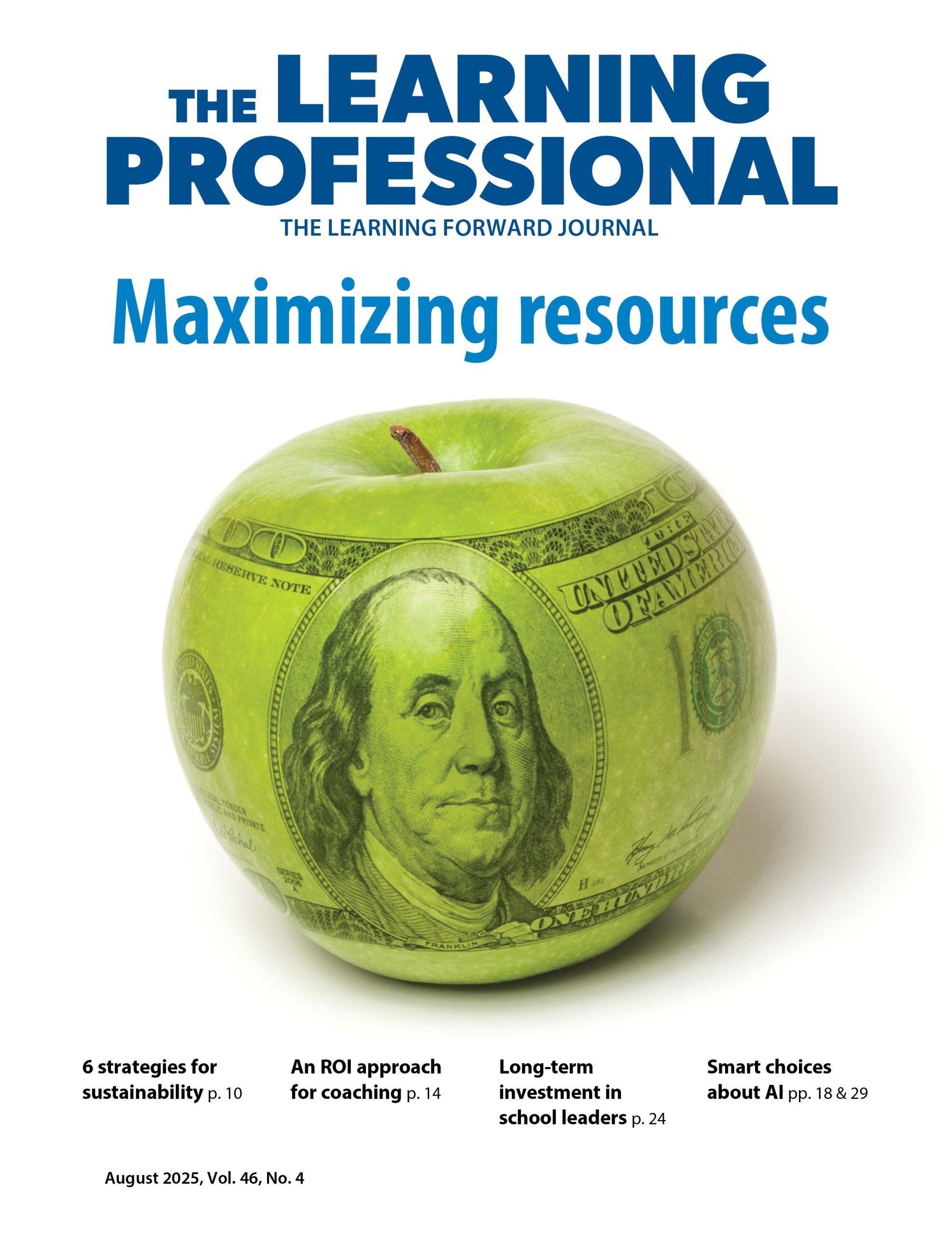
MAXIMIZING RESOURCES
August 2025
This issue offers advice about making the most of professional learning...