Learning Forward
Equity and excellence in teaching and learning.

FOCUS
Leadership teams make change that lasts
By Jody Spiro and Paul Fleming
Categories: Implementation, Leadership, Learning communities, Learning systems/planningOctober 2025

Leadership teams have real power to drive improvement in schools by harnessing multiple experts’ valuable perspectives and collaborative capacity. The benefits of leadership teams are many, as we have described previously (see the Leadership Teams recurring column in 2024 issues of The Learning Professional). But even seasoned team members may not recognize their potential to address a persistent challenge in education: sustaining improvements over time. There is therefore good reason and evidence to develop and continuously improve them as agents of change for schools or school systems.
As Fleming (2025) wrote, “Sustainability is an important but often elusive goal in educational improvement. Too often, even successful initiatives … begin with great promise and enthusiasm only to fade away after pilot projects and initial trainings end, funding runs out, or leaders move on to new roles” (p. 10). Fleming laid out six strategies for sustainability.
School- and/or system-based leadership teams provide an additional strategy for addressing this problem. When several educators with varied roles (and sometimes from different organizations) work together to not only develop a successful initiative but also build partnerships, policies, and culture, the high-quality work is likely to continue even when the team experiences turnover of individual members. Fortunately, such sustainability can be intentionally planned and carried out over time. Even if the work is not sustained initially, good planning from the start can result in future leaders bringing it back thanks to the partnership, policies, and culture established by the team.
The leadership team framework
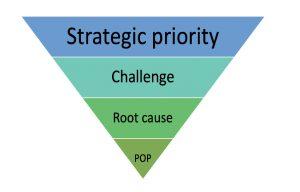
Intentionality about long-term outcomes is a cornerstone of Learning Forward’s Leadership Team Institute, in which district and school teams learn about processes and tools for improvement. The schools and systems participating in the institute have each been working on building team capacity and effectiveness as applied to a problem of practice tied to strategic priorities. They expend considerable effort determining the question they will try to address by analyzing their own context within the following framework:
First, teams discuss their readiness to engage by assessing their current skills and team climate against evidence-based practices using a team readiness tool we developed for the institute, discussing and reaching consensus on needed improvements.
The next steps are depicted in the figure, starting with the step at the top. As the figure shows, teams increasingly narrow their focus as they progress through the stages. This begins with defining potential improvements and identifying the improvement that is most needed. They identify a strategic priority and then a challenge that is preventing its achievement. Identifying a strategic challenge is important, because individuals and teams often feel tempted to race to a solution without fully understanding or finding consensus on the problem.
Once the challenge is defined, teams work to identify its root cause or causes. Without this step, teams might end up making progress on solving a problem that lies outside the larger priority they have identified or one that does not solve the real problem.
The framework contributes to potential sustainability since it furthers a strategic priority in ways that are specific, memorialized in policy, and shared by several partners, all of which embed it in the culture.
Planning for sustainability
Teams make plans for sustainability early on. They only implement the plan if the initial work is of high quality and is effective in addressing the problem. In developing the plan, and later during implementation if needed, teams consider the following questions:
- What are our measurable goals, and how do we gather relevant and timely data to assess our progress?
- What partnerships can we build so there is always someone to carry on the work if there is turnover in one or more positions?
- How can we embed our work in policy?
- Are there additional funding sources we can try to find (even if the current funding is not endangered at this time)?
- How can we build this work into the values and priorities of the larger community and our day-to-day culture?
- How can we build ongoing and personalized professional learning into this work?
Examples from the field
Here are three brief examples of school systems participating in the Leadership Team Institute that are following these steps to build sustainability in their work.
Pasco County Schools in Florida has participated in the Leadership Team Institute for two years. Their team developed a problem of practice to address their strategic priority of increasing student engagement in all classrooms by asking, How can we increase student engagement through collaborative structures that improve academic achievement, behavior, and attendance from the 2023-24 school year onward? Their leadership team then developed collaborative structures such as staff surveys, administrator walk-throughs, and classroom visits to highlight effective teaching practice.
The district has improved educator practice and thereby improved student achievement. Pasco’s student achievement data shows across-the-board increases on the Florida Statewide Assessments from 2023 to 2024 in 6th through 8th grade student English language arts and science scores as well as increased math scores for 6th and 8th graders. The biggest gain was for district 6th-grade students, whose English language arts scores improved by 14% over the year before the collaborative structures were implemented.
The team is optimistic these gains will be sustained, since team members include a district leader, principal, assistant principal, and teacher leader to carry on the work and make improvements as they go. This vertical team has also served as a catalyst for other school-based teams in the district to take up similar student engagement strategies aligning to their respective school goals and strategic priorities.
A team from the Delaware State Department of Education uses the Leadership Team Institute as a capstone program for those districts that participate in its principal pipeline program — if a district successfully creates a principal pipeline to develop, select, hire, train, and evaluate aspiring principals, it is given a grant to participate in the Leadership Team Institute. This allows the districts that are already making progress with developing and implementing systems to build a leadership team to carry on and improve that work for long-term sustainability. While these district teams vary in student enrollment, funding, and strategic priorities, they share a common focus and continuous improvement model through the Leadership Team Institute that equips them with strategies for long-term success.
Putnam/Northern Westchester BOCES, a regional support center working with over 50 districts in New York state, is a new participant in the Leadership Team Institute for 2025. Through the institute, their team aspires to develop stronger processes around gathering professional learning impact data and sustain the use of those data collection and evaluation processes into the future. The BOCES team, made up of professional learning leaders from across the organization, sees the importance of alignment in data collection and evaluation processes as critical to ensuring effectiveness of service to districts.
Making change last
Making impactful improvements requires an effective and supportive team, not only to identify and address strategic challenges but to ensure teams and structures are in place to keep those programs going. Leadership teams that comprise high-quality partnerships and cohesive policies are essential. They can leverage and build on other sustainability strategies such as those identified by Fleming (2025). No matter how skillful, no leader can do this work alone and be truly successful for the long term. Effective teams can make all the difference in not only building and continuously improving results for all educators and students, but sustaining them.
Download pdf here.
References
Fleming, P. (2025). 6 strategies for sustainable professional learning. The Learning Professional, 46(4), 10-13.

Jody Spiro (jodyspiro50@gmail.com) is a professor and author in education leadership and systems change and a senior advisor to Learning Forward.

Paul Fleming serves as Deputy CEO and Chief Learning Officer at Learning Forward. His current areas of focus include leading the effective implementation of the Standards for Professional Learning and corresponding tools, the expansion of our professional services and leadership and learning series teams, and multiple consulting projects with states and districts to increase educator and leader effectiveness through student-focused, high quality professional learning.
Categories: Implementation, Leadership, Learning communities, Learning systems/planning


CURRENT ISSUE
Recent Issues

LEARNING WITH AI
February 2026
Generative AI can be a powerful tool for professional learning design and...
WHAT STUDENTS NEED NOW
December 2025
For all students to thrive, we need to understand who they are and what...
LEARNING COMMUNITIES FOR LEADERS
October 2025
Leaders need opportunities to connect, learn, and grow with peers just as...

MAXIMIZING RESOURCES
August 2025
This issue offers advice about making the most of professional learning...