Learning Forward
Equity and excellence in teaching and learning.


It’s not easy to be a young person today. By many metrics, children and youth in developed countries are struggling. It’s widely recognized that academic outcomes are concerning, especially in the U.S., where 31% of public school students were behind grade level at the end of the 2024-25 school year (Annie E. Casey Foundation, 2025). But indicators of health and well-being are at least as troubling, if not more so.
In 2023, 40% of young people in the U.S. experienced persistent feelings of sadness or hopelessness and 29% experienced poor mental health (CDC, 2024). In 2022, 34% of Canadian young peopled reported poor mental well-being and 23% reported feeling lonely most of the time, while in the United Kingdom, only 16% reported high satisfaction with their lives (OECD, 2025).
The stresses and challenges for young people are many. One in six U.S. children lives in poverty and one in three lives in a household struggling with housing costs (Annie E. Casey Foundation, 2025). Approximately 40% of young people in a 2025 study of high-income countries said they were concerned about rising prices (The Children’s Society, 2025).
Five years after the onset of the COVID-19 pandemic, 79% of public school leaders believe the pandemic’s lingering effects continue to negatively impact students’ socioemotional development, and 76% think the same about student behavior (NCES, n.d.).
And, of course, the ubiquity of digital media presents ongoing challenges. One-third of girls ages 11-15 say they are addicted to social media (Office of the Surgeon General, 2023) and approximately two-thirds of young people say they are exposed to hate-based content online (CDC, 2024). More than half of public school leaders report that cell phone use has negatively impacted their students’ academic performance, mental health, and attention spans (NCES, n.d.).
At the same time, today’s youth have unique strengths and opportunities. Many are keenly tuned in to social issues and committed to making the world better (Booth & Medina, 2024). Access to digital tools has made them more globally aware and active (Friel, 2021). They have opportunities to create new jobs and new fields even as the doors to some traditional pathways close. Many of their biggest challenges and their biggest opportunities are intertwined.
In short, things are complicated for today’s students. That means our solutions have to be nuanced and responsive. Students are not static. Our schools shouldn’t be either. To serve students well and ensure they all thrive, we need to understand who young people are today and what they need now. This issue’s authors look closely at those questions and explain how they are using what they learn to improve teaching and learning.
These authors listen deeply to students and help them connect their lives in and outside of school. They codesign solutions and assessments. They look at data to question their assumptions and rethink their past approaches. They bring all educators, not just specialists, into meeting the needs of multilingual students and students with disabilities.
These authors’ stories, tools, and insights inspire me, and I hope they inspire you too, so we don’t overlook the people who have the most to teach us: students.
References
Annie E. Casey Foundation. (2025). 2025 Kids Count Data Book. tinyurl.com/4mc5cm95
Booth, R.B. & Medina, A. (with Freeman, J. and Hilton, K.). (2025). Youth are taking civic action, but need opportunities and support to overcome socioeconomic barriers. Center for Information & Research on Civic Learning and Engagement (CIRCLE). tinyurl.com/4dssd7d7
Centers for Disease Control and Prevention. (2024). Youth Risk Behavior Survey Data Summary & Trends Report: 2013–2023. U.S. Department of Health and Human Services. tinyurl.com/we8s2cdx
The Children’s Society. (2025). The Good Childhood Report 2025. tinyurl.com/pecfvpfd
Friel, S. (2021). Modern-day youth activism: Youth engagement in the digital age. Global Fund for Children. tinyurl.com/mn37994f
National Center for Education Statistics. (n.d.). School Pulse Panel: Surveying high-priority, education-related topics. Institute for Education Sciences, U.S. Department of Education. tinyurl.com/2uu774sd
OECD. (2025). OECD Child & Well-Being Dashboard. tinyurl.com/537wwbma
Office of the Surgeon General. (2023). Social media and youth mental health: The U.S. Surgeon General’s advisory. U.S. Department of Health & Human Services. tinyurl.com/5n926a7v

Suzanne Bouffard is senior vice president of communications and publications at Learning Forward. She is the editor of The Learning Professional, Learning Forward’s flagship publication. She also contributes to the Learning Forward blog and webinars. With a background in child development, she has a passion for making research and best practices accessible to educators, policymakers, and families. She has written for many national publications including The New York Times and the Atlantic, and previously worked as a writer and researcher at the Harvard Graduate School of Education. She has a Ph.D. in developmental psychology from Duke University and a B.A. from Wesleyan University. She loves working with authors to help them develop their ideas and voices for publication.
CURRENT ISSUE
Recent Issues
LEARNING WITH AI
February 2026
Generative AI can be a powerful tool for professional learning design and...
WHAT STUDENTS NEED NOW
December 2025
For all students to thrive, we need to understand who they are and what...
LEARNING COMMUNITIES FOR LEADERS
October 2025
Leaders need opportunities to connect, learn, and grow with peers just as...
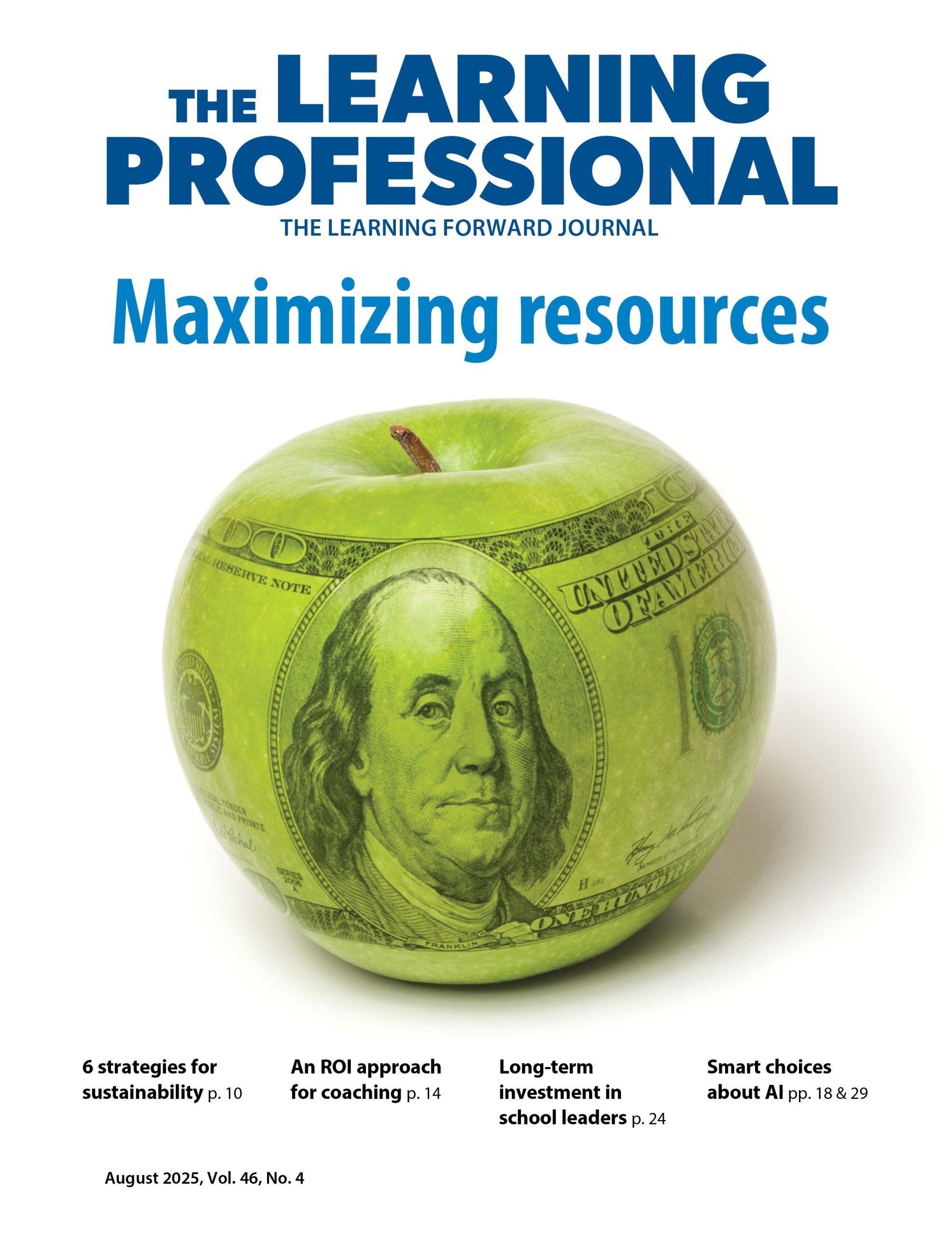
MAXIMIZING RESOURCES
August 2025
This issue offers advice about making the most of professional learning...