
Learning Forward
Equity and excellence in teaching and learning.

FOCUS
Principals needed support. They found it in a PLC.
By Carly Weiland Quiros
Categories: Collaboration, Implementation, Leadership, Learning communities, School leadershipOctober 2025

In the winter of 2024, a group of school administrators from a district we’ll call Plains Public School District (a pseudonym) gathered around a conference table for a routine professional learning session. In the suburban district of four schools, principals had recently adopted a revised teacher evaluation model rooted in a shared vision: to provide every educator with actionable, growth-oriented feedback that supports student learning. The model aligned with state guidelines for educator evaluation and emphasized professional standards, multiple measures, and a developmental purpose. Rollout challenges had surfaced quickly, however. Despite a strong vision and thoughtful planning, implementation varied significantly across schools. Observation practices, feedback consistency, and the use of a standardized evaluation rubric fluctuated. Some principals were confident in their feedback, while others avoided
Read the remaining content with membership access. Join or log in below to continue.
Sed ut perspiciatis unde omnis iste natus error sit voluptatem accusantium doloremque laudantium, totam rem aperiam, eaque ipsa quae ab illo inventore veritatis et quasi architecto beatae vitae dicta sunt explicabo. Nemo enim ipsam voluptatem quia voluptas sit aspernatur aut odit aut fugit, sed quia consequuntur magni dolores eos qui ratione voluptatem sequi nesciunt. Neque porro quisquam est, qui dolorem ipsum quia dolor sit amet, consectetur, adipisci velit, sed quia non numquam eius modi tempora incidunt ut labore et dolore magnam aliquam quaerat voluptatem.
Structures that strengthened our PLC
Each monthly session of the principal PLC included job-embedded practices that built confidence and consistency among leaders, including:
- Video-based observation calibration using real classroom footage
- Sample feedback analysis with rubric-aligned language comparisons
- Rehearsal of post-observation conversations in small groups
- Structured problem of practice protocols (e.g., dilemma protocols)
- Codeveloped feedback language guides and templates
- Peer reflections and check-ins to track learning and adaptation
These learning structures can be adapted and applied with other role-alike groups.
References
Cohen, J., Loeb, S., Miller, L.C., & Wyckoff, J.H. (2020). Policy implementation, principal agency, and strategic action: Improving teaching effectiveness in New York City middle schools. Educational Evaluation and Policy Analysis, 42(1), 134-160.
Derrington, M.L. & Campbell, J.W. (2015). Implementing new teacher evaluation systems: Principals’ concerns and supervisor support. Journal of Educational Change, 16(3), 305-326.
Donaldson, M. & Mavrogordato, M. (2018). Principals and teacher evaluation: The cognitive, relational, and organizational dimensions of working with low-performing teachers. Journal of Educational Administration, 56(6), 586-601.
Donaldson, M.L. (2013). Principals’ approaches to cultivating teacher effectiveness: Constraints and opportunities in hiring, assigning, evaluating, and developing teachers. Educational Administration Quarterly, 49(5), 838-882.
Donaldson, M.L. & Firestone, W.A. (2021). Rethinking teacher evaluation using human, social, and material capital. Journal of Educational Change, 22(5), 501-534.
Donaldson, M.L. & Woulfin, S. (2018). From tinkering to going “rogue”: How principals use agency when enacting new teacher evaluation systems. Educational Evaluation and Policy Analysis, 40(4), 531-556.
Weick, K.E. (1995). Sensemaking in organizations. Sage Publications.
Woulfin, S.L., Donaldson, M.L., & Gonzales, R. (2015). District leaders’ framing of educator evaluation policy. Educational Administration Quarterly, 52(1), 110-143.

Carly Weiland Quiros is a professional learning specialist at EdAdvance, a regional education service center in Connecticut, and a doctoral student at the University of Virginia. She partners with districts to strengthen principal and teacher leadership and to build educator growth systems that are meaningful, coherent, and grounded in relational trust.
Categories: Collaboration, Implementation, Leadership, Learning communities, School leadership



CURRENT ISSUE

Recent Issues

LEARNING WITH AI
February 2026
Generative AI can be a powerful tool for professional learning design and...

WHAT STUDENTS NEED NOW
December 2025
For all students to thrive, we need to understand who they are and what...
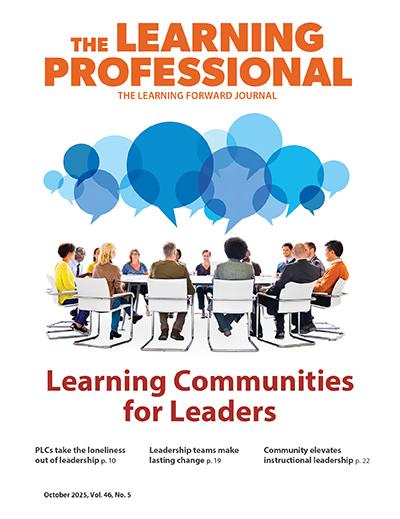
LEARNING COMMUNITIES FOR LEADERS
October 2025
Leaders need opportunities to connect, learn, and grow with peers just as...

MAXIMIZING RESOURCES
August 2025
This issue offers advice about making the most of professional learning...