
Learning Forward
Equity and excellence in teaching and learning.

IDEAS
Teacher teams that lead to student learning
By Diane Zimmerman and James Roussin
Categories: Change management, Collaboration, Learning designs, Teacher leadershipDecember 2023

In many schools, teams come together primarily to plan events, build common assessments, or determine curriculum or grade-level planning. But teams often struggle to make teamwork an inquiry-driven process that focuses on problems of practice and student learning. The essential focus of teams should be on building collective responsibility (Hargreaves & O’Connor, 2017). Research shows that teacher teams that make links to teaching practices are more effective when compared to teams with less intense forms of collaboration (Meirink et al., 2010). In 2019, we collaborated with our colleague Robert Garmston on a book, Transforming Teamwork: Cultivating Collaborative Cultures, which focused on this question: What essential conditions have the most leverage for transforming collaborative groups? We drew on seminal work about professional learning communities and team
Read the remaining content with membership access. Join or log in below to continue.
Sed ut perspiciatis unde omnis iste natus error sit voluptatem accusantium doloremque laudantium, totam rem aperiam, eaque ipsa quae ab illo inventore veritatis et quasi architecto beatae vitae dicta sunt explicabo. Nemo enim ipsam voluptatem quia voluptas sit aspernatur aut odit aut fugit, sed quia consequuntur magni dolores eos qui ratione voluptatem sequi nesciunt. Neque porro quisquam est, qui dolorem ipsum quia dolor sit amet, consectetur, adipisci velit, sed quia non numquam eius modi tempora incidunt ut labore et dolore magnam aliquam quaerat voluptatem.
References
Garmston, R. & Zimmerman, D. (2013, April). The collaborative compact: Operating principles lay the groundwork for successful group work. JSD, 34(2), 10-14.
Hargreaves, A. & O’Connor, M.T. (2017). Cultures of professional collaboration: Their origins and opponents. Journal of Professional Capital and Community, 2, 74-85.
Hord, S.M. (2008). Evolution of the professional learning community: Revolutionary concept is based on intentional collegial learning. JSD, 29(3), 10-13.
Janis, I.L. (1973). Victims of groupthink: A psychological study of foreign-policy decisions and fiascoes. Houghton-Mifflin.
Meirink, J., Imant, J., Meijer, P., & Verloop, N. (2010). Teacher learning and collaboration in innovative teams. Cambridge Journal of Education, 40(2), 161-181.
Reynolds, M. (2014). The discomfort zone: How leaders turn difficult conversations into breakthroughs. Berrett-Koehler.
Senge, Peter M. (1991). The fifth discipline: The art and practice of the learning organization. Bantam Doubleday Dell Publishing
Wenger, E. (1998). Communities of practice: Learning, meaning, and identity. Cambridge University Press.
Wheatley, M. (1999, September). Bringing schools back to life: Schools as living systems. www.margaretwheatley.com/articles/lifetoschools.html

Diane P. Zimmerman (dpzimmer@gmail.com) is a retired superintendent and author.

James L. Roussin (jim.roussin@gmail.com) is executive director of Generative Learning.
Categories: Change management, Collaboration, Learning designs, Teacher leadership



CURRENT ISSUE

Recent Issues

LEARNING WITH AI
February 2026
Generative AI can be a powerful tool for professional learning design and...

WHAT STUDENTS NEED NOW
December 2025
For all students to thrive, we need to understand who they are and what...
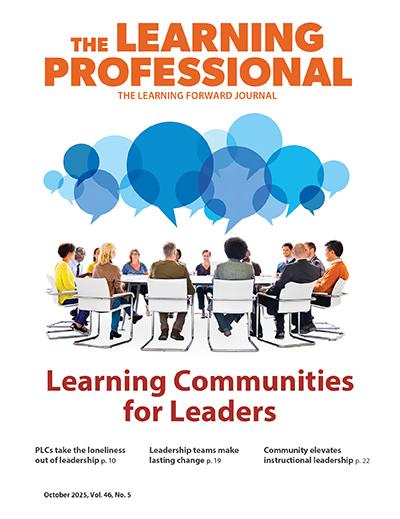
LEARNING COMMUNITIES FOR LEADERS
October 2025
Leaders need opportunities to connect, learn, and grow with peers just as...

MAXIMIZING RESOURCES
August 2025
This issue offers advice about making the most of professional learning...