
Learning Forward
Equity and excellence in teaching and learning.

FOCUS
Instruction improves when Denver teachers dive deep on technology
By Drea Aguirre, Lucas Mund and Britney Hermosillo
Categories: Career pathways, Coaching, Learning designs, TechnologyApril 2024

With the ever-expanding role of technology in schools, many teachers have participated in one-time, stand-alone workshops to learn how to use a new program, app, or other tool. While that may provide a helpful introduction to the basics and highlight inspirational examples of what the tool can do, it doesn’t often translate into teachers applying the technology in valuable ways to improve student learning.
That’s why Denver (Colorado) Public Schools’ educational technology team decided to shift from large-scale workshops to more intensive coursework and coaching about technology integration. As a result of this shift, we are seeing measurable improvements in teachers’ instructional practices and classroom environments.
We are also seeing encouraging trends in educator retention and career advancement. The real beneficiaries of all those changes, however, are students.
Making the shift
In 2016, Denver voters approved a bond to fund several improvements to schools, including a program to grow a one-to-one computing initiative. Interested schools applied to receive a device for each student, along with coaching to help them use the devices.
In 2020, when the onset of the COVID-19 pandemic forced school building closures and devices became essential for every student, the whole district became one-to-one. That opened an opportunity for us to help our district shift from focusing on access to focusing on meaningful integration of technology.
To make this shift, we knew professional learning was essential. We moved from supporting a few pilot schools to large-group professional learning sessions for the entire district — for example, on how to navigate the Schoology information system and how to teach students to create graphic designs in Canva.
However, we quickly realized this approach wasn’t enough. Teachers weren’t implementing the strategies after the sessions. Even when we offered coaching, many teachers would attend an initial meeting, work on a lesson plan, but then get too busy to follow through or meet with their coach again.
To help our teachers dig deeper into technology strategies, we began offering a longer-term professional learning experience, with job-embedded coaching cycles, based on research showing that coaching is one of the most effective ways to achieve changes in instructional practices (Kraft et al., 2018). We have further incentivized this process by formatting this learning as a Professional Development Unit (PDU), which allows teachers to receive credit toward salary lane changes.
A PDU provides differentiated, action-oriented learning that has clear application to practice and is designed to help teachers acquire or improve skills focused on topics of student need, including closing the opportunity gap. Different from the district’s mandated professional learning, PDUs are voluntary, 45-hour learning opportunities designed to help educators advance their professional practice.
Our team works with the district’s professional learning team to ensure that all PDUs are equivalent to rigorous, graduate-level coursework. Teachers who complete a PDU receive credits that they can use not only toward license renewal, but also toward salary advancement, in accordance with the district’s process for increasing salaries based on experience and education levels. A PDU counts for two or three credits toward an 18-credit threshold for a bump to the next salary level, which we refer to as “lane-changing.”
In addition to participating in large-group learning, teachers engage in reading, planning, and especially coaching. At the end of the course, teachers engage in a group peer reflection. Those sessions are a powerful way for teachers to share, recognize growth, learn from each other, and celebrate success.
Benefits of coaching
Our team’s PDU, STEAM Strategies to Ignite Learning (see box at right), includes two full coaching cycles in which teachers choose a strategy from the whole-group learning, integrate it into their instructional practice, and then engage with the coach in reflection on their implementation.
The specific coaching approach is tailored to individual teachers’ needs. Some teachers choose to co-plan lessons with the coach, some ask coaches to observe or co-teach, and others only want to debrief and reflect with the coach.
Because the PDU is designed to occur over the course of the school year, teachers can engage with coaches at any time during the year. This not only provides flexibility for teachers, but it helps coaches and teachers develop an ongoing relationship that leads to meaningful engagement, real learning, and strong implementation.
We find that having this relationship with a coach helps teachers keep on pace. Teachers have many things on their plates, so being accountable to someone helps them implement the strategies. Coaches also give them tangible, instrumental support because we can sit down with them to plan, share resources, and complete steps that might take them several hours on their own. Once they see the benefits of the first coaching cycle and hear their coaches’ encouragement to keep learning and keep working toward the PDU credit, this helps them stay on track.
Piquing teachers’ interest
We have found that the connection between the PDU and the opportunity for increased pay is a major motivator for teachers. It contributes to teacher retention, both because it helps teachers advance within our district and because the credits are not transferrable to other districts.
This structure is particularly attractive to experienced teachers, and therefore helps fill a gap many districts see in later-career professional learning. Early career teachers have more content-focused professional learning they are mandated to attend, and they may feel overwhelmed by adding an additional 45-hour course to their already-busy schedules.
Still, teachers of all experience levels are busy and often stressed, so the PDU aims to accommodate that. We have made it very clear that dates are suggestions, not hard-and-fast deadlines. We also recognize that not all teachers will complete the PDU in the allotted time frame, and we encourage them to stay in touch with us and seek our coaching support when it works for them.
Word-of-mouth is the most powerful factor that drives teachers to participate. Initially, we found that many teachers were hesitant to embark on this work with us because they had had negative experiences with coaching approaches that were paired with evaluation. Our coaching is nonevaluative, which is an essential part of making teachers feel safe to take risks and try new things with instructional technology.
Over the last few years, we have seen participation increase, compared to before we implemented the full, coaching-centered model. After we revamped the structure, we saw an initial dip in participation, likely because teachers weren’t accustomed to the scope of the commitment. But after one year, participating teachers shared their positive experiences with colleagues, and word-of-mouth has driven increased interest and higher participation numbers.
Each year that we’ve offered the PDUs, participation is typically 30 to 40 teachers. In the past, about 20 teachers per year would participate and complete the requirements, but we are seeing those numbers go up to 30 to 40 teachers per year.
How we document and measure success
It’s important for us to collect data that shows whether our work is having an impact on instruction and student outcomes. At the same time, we want to make sure that we are not doing documentation just for documentation’s sake. The documentation needs to be simple and straightforward for the people who are doing it.
We try to balance the workload between teachers and coaches. When we engage in coaching observations, we take photos, save documents, and take notes. When we do reflections with teachers, we write down their thoughts. We share all of this with the teachers so they can learn from it and also use it as the basis of the documentation they’re required to do. There is always room for improvement, so we continue refining the documentation templates to make them as clear as possible and give examples.
Before they engage with any of the material, teachers complete a preassessment of their skills and coaches complete a parallel assessment based on a classroom observation. We compare those reports to identify skills where teachers and coaches agree and disagree. We often find that teachers rate themselves more highly than coaches do because they are not yet familiar with the look-fors — in other words, they don’t know what they don’t know.
The discrepancy provides a valuable opening for conversation. For example, if a teacher rates herself as 15 out of 16 on a measure of creating joyful classroom spaces, but the coach only rates her an 8, they talk about the gap and how the teacher can focus her learning in the PDU to improve her ability to engage and inspire students.
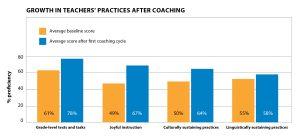
Coaches then use the same tool — an instructional rounds walk-through tool created by Student Achievement Partners (2023) — for their observations during the coaching cycles, which allows them to see and document growth. After the first coaching cycle in school year 2023-24, average scores went from 9.36 to 11.61 on a 17-point scale. Teachers’ scores increased on all four domains of instructional practice measured:
- Grade-level texts and tasks (ensuring instruction reflects the focus, coherence, and rigor required by college- and career-ready standards);
- Joyful instruction (ensuring instruction is designed to create a sense of belonging and competence with content, and empowering students to exercise agency in their learning);
- Culturally sustaining practices (ensuring that instruction is designed to leverage the diverse backgrounds of students as assets and facilitate inquiry into relevant contexts); and
- Linguistically sustaining practices (ensuring instruction leverages the linguistic repertoires and backgrounds of students to support multilingualism and the simultaneous development of content knowledge and language).
Teachers improved their practices most on the first two areas, from 61% to 78% proficiency on grade-level texts and tasks and from 49% to 67% proficiency on joyful instruction. We will continue to measure changes in teacher practices after they complete their second coaching cycle.
High-quality integration of technology
Throughout the coaching cycles, we are seeing more authentic, high-quality implementation of technology integration practices that are covered in the PDU. Teachers are doing more innovative things in their classrooms, like students using Canva to design, build, and present a news report on various types of extreme weather events. The active role of students in researching and presenting content has fostered a high level of ownership, resulting in increased engagement.
We also see a change in teachers’ and administrators’ understanding of and expectations for what students can do, especially young students. When educators see their peers using technology in ways they didn’t know were possible, it motivates other educators to try it, too.
The number of teachers who have participated so far, about 90, represents a small percentage of the district’s 7,400 teachers. As we’ve shifted to PDUs, we have had to shift our mindset from quantity to quality.
At the same time, we believe our efforts are having an impact beyond the teachers who have participated directly. As part of the reflection component of the coaching cycles, we encourage teachers to plan to share their learning and new strategies with their teams or in other departments. Teachers tell us this is helping get their colleagues excited about using new technology strategies.
In addition, we are seeing encouraging signs that participating teachers are staying in the district and even moving to leadership positions like assistant principal and principal, where they can magnify their impact to more teachers and more students and also become advocates for technology integration. Teachers tell us that tying the PDU credits to lane changes and eventual salary increases is a big part of this.
For our team, the shift from large-group presentations to more in-depth, year-long support was initially difficult. But after several years of PDU cohorts, we can see instructional shifts and feel confident the effort was worth it because we are investing in long-term improvements in the district’s use of technology.
STEAM Strategies to Ignite Learning Professional Development Unit
Course description:
This Professional Development Unit (PDU) offers an opportunity to explore impactful instructional methods using technology and tools to increase STEAM connections in your classroom. You’ll learn to integrate communication, collaboration, creativity, and critical thinking (4C’s) authentically into your lessons, fostering a positive, relevant, and rigorous classroom experience for all students.
Through collaboration with teachers districtwide, you’ll discover strategies to implement the 4C’s and promote meaningful student engagement. The PDU includes individualized, nonevaluative coaching and support from one of our instructional digital coaches.
Participants will delve into instructional strategies for each of the 4C’s, emphasizing purposeful technology integration. Each participant will choose two C’s for a deep dive, developing and implementing strategies supported by coaching and reflection. Implementation will be observed and/or recorded, with student work collected to ensure effectiveness. Participants will also share their deep dives with peers for feedback and review.
Course objective:
To support teachers to develop and implement instructional strategies that authentically integrate communication, collaboration, creativity, and critical thinking (4C’s) into classroom practices, fostering a positive, relevant, and rigorous learning environment for all students.
References
Kraft, M.A., Blazar, D., & Hogan, D. (2018). The effect of teacher coaching on instruction and achievement: A meta-analysis of the causal evidence. Review of Educational Research, 88(4), 547-588.
Student Achievement Partners. (2023). e2 Instructional Practice Suite. Author. www.learnwithsap.org/e2

Drea Aguirre (andrea_swiney1@dpsk12.net) is a digital coach at Denver Public Schools in Colorado.

Lucas Mund (lucas_mund@dpsk12.net) is an educational technology leader from Denver. After a decade of teaching social studies and technology, Mund transitioned into roles as a digital coach and edtech manager, driven by his passion for integrating technology meaningfully into instruction. His dedication lies in leveraging technology to unlock the vast potential of students, believing in its power to transform learning experiences and pave the way for limitless possibilities.

Britney Hermosillo is an educational technology specialist with Denver Public Schools who is dedicated to helping create opportunities for leaders, teachers, and students to impactfully implement technology as part of their daily educational ecosystem. Hermosillo has over 12 years of experience in education both in the classroom and with instructional coaching. Her passion is to advance educational technology in ways that ensure equitable opportunities for all students, fostering an inclusive environment where every learner can excel in the digital landscape.
Categories: Career pathways, Coaching, Learning designs, Technology


CURRENT ISSUE
Recent Issues

LEARNING WITH AI
February 2026
Generative AI can be a powerful tool for professional learning design and...

WHAT STUDENTS NEED NOW
December 2025
For all students to thrive, we need to understand who they are and what...

LEARNING COMMUNITIES FOR LEADERS
October 2025
Leaders need opportunities to connect, learn, and grow with peers just as...

MAXIMIZING RESOURCES
August 2025
This issue offers advice about making the most of professional learning...