

The Learning Professional team is pleased to announce the themes for the journal’s 2026 issues. This set of issues will feature both newly urgent topics, such as AI and neuroscience developments, and in-depth looks at timeless topics like coaching. We invite submissions for the following issues:
- AI in professional learning
- The science of learning
- Coaching for all
- Teacher voice
- Differentiating learning
Each issue will highlight strategies for ensuring that all educators are equipped to support all students’ needs, using the latest research and tools. We’ll delve into how to differentiate professional learning according to both educators’ and students’ specific needs while also ensuring consistency and coherence. As always, we will emphasize alignment to the Standards for Professional Learning.
Note that every issue of The Learning Professional also contains non-thematic articles, so if you have a professional learning story to tell or a strategy to share that doesn’t fit in one of these categories, we welcome you to submit it at your convenience.
Before you submit an article, be sure to familiarize yourself with our focus and style and take a look at the submission guidelines on the Write for Us page. Please note that we have a new set of generative AI guidelines to help authors and our team navigate the quickly evolving role of AI in publications. You’ll find the guidelines on the Write for Us page. Please review the guidelines and doublecheck all submitted content for accuracy.
Below are detailed descriptions of the themes for which we are currently accepting submissions, along with deadlines.
AI in professional learning: February 2026
Artificial intelligence is rapidly shifting the landscape of education. What are the implications for professional learning? This issue will examine a variety of uses of AI in professional learning, from coaching to professional learning communities to online courses. Articles might share research, frameworks, personal experiences, and advice for how to – and perhaps how not to – integrate AI into professional learning. Authors are encouraged to cover advantages, limitations, and key considerations for users.
Submission deadline: December 15, 2025
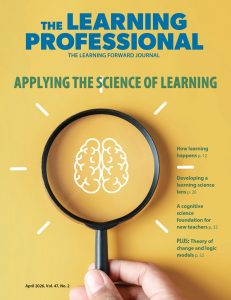
The science of learning: April 2026
Research from neuroscience and cognitive psychology illuminates many facets of how we learn. Integrating that knowledge into professional learning is essential for ensuring that learning designs improve educators’ knowledge and skills and ultimately benefit students. This issue will explore advances in the learning sciences and how to apply them in professional learning. Articles might include how schools are designing their professional learning experiences in alignment with neuroscience principles such as minimizing cognitive load and chunking information, how professional learning can model science-based approaches to teaching and learning that educators can then apply with their classrooms, and stories of how schools are moving away from learning theories that have been debunked (e.g., learning styles). Real-world examples will be given priority, but theoretical contributions and advice are also welcome.
Submissions due January 15, 2026
Coaching for all: June 2026
High-quality coaching benefits educators in all roles including teachers, principals, central office leaders, and even coaches themselves. This issue will explore best practices and recent research in coaching. Articles might examine successful leadership coaching strategies, system-wide approaches that differentiate coaching by role, and support for developing coaching skills. Articles may provide advice for coaches and their supervisors or for the teachers and leaders who work with coaches. Tools and processes for supporting coaching are also welcome.
Submissions due March 1, 2026
Teacher voice: August 2026
Meaningful learning opportunities for teachers simultaneously address system-wide goals for rigorous student learning and encourage teachers’ agency and authority as experts. This issue will highlight approaches and examples of professional learning that embody that combination and foster teachers’ choice, leadership, and self-efficacy. Articles might address policies and structures that encourage teacher-driven professional learning, advice for facilitators about encouraging all teachers’ input and engagement, and how to overcome barriers to authentic teacher voice. Authors are encouraged to write from a variety of perspectives – teacher, school leader, professional learning facilitator, and beyond.
Submissions due May 1, 2026
Differentiating learning: October 2026
Differentiation is key for meeting all students’ needs but is often cited as one of the biggest challenges for educators. This issue will explore how professional learning can build educators’ capacity to differentiate instruction to students with neurodiverse profiles, varying levels of skill, types of language proficiency, and more. Articles might explore how professional learning approaches such as learning walks and coaching help teachers learn to differentiate instruction, how to build teachers’ capacity for implementing rigorous high-quality curriculum in ways that meet all students’ specific needs, and how differentiating professional learning can provide modeling for differentiating student instruction.
Submissions due July 1, 2026