

In this second part of Learning Forward’s blog series on the CalTex Curriculum-Based Professional Learning Network, we’re highlighting the work of Grow Public Schools, a charter network focused on serving students in the underserved areas of Kern County, California. Two schools—Grow Academy Arvin and Grow Academy Shafter—are participating in Learning Forward’s latest CBPL Network, which launched in fall 2025. For more background on the CalTex CBPL Network, please see our first blog post here.
Like all schools participating in the CalTex network, the two Grow campuses are focused on implementing high-quality mathematics curriculum with integrity and navigating the complex change management issues that accompany pedagogical shifts and exploring something different. Grow’s CalTex team is led by Tatiana Mirzaian, director of Learning and Innovation. In this spotlight, we focus on three standout aspects of Grow’s work: Use of practical measures; tools for efficient and effective planning, and; leadership.
Use of practical measures
The selection and careful use of practical measures as part of a larger system of measures is a core feature in Learning Forward’s networks. The right measures help us learn whether changes are actually improvements and provide teams with timely feedback on the trajectory of longer-term success or failure. Practical measures are formative in nature and are designed to address challenges that are either process-oriented (e.g. frequency or time) or performance outcome-oriented (at either educator or student levels). As part of a continuous improvement cycle, these measures give us confidence that the change is putting us on the right pathway to the summative improvement we’re pursuing.
At Grow, educators are using practical measures for both process and formative student outcome improvement. These measures help individual teachers improve their own practice through individual reflection and work with Tatiana, and within structured peer teacher planning time that allows sharing and collaboration based on data. Examples of measures being used in Grow’s Illustrative Mathematics (IM) implementation include classroom timing to guide implementation of IM’s lesson structure, and multiple sources of formative student outcomes. Campus teams are digesting the data in a structured manner with Tatiana’s oversight using a PDSA process.
As an example, in a recent 6th grade planning meeting, teachers focused on “quick check” student results and common areas of student struggle with collaboration on promising practices and next steps for implementation in coming lessons. Teachers used their time to discuss and debate mathematical content and learning sequences as well as instructional details.
Tools for efficient and effective planning
Professional learning supports and grade-level planning are assisted by common tools that enable sophisticated planning and efficient meetings. Overall Illustrative Mathematics lesson architecture and calendars are planned in advance for the full year using Grow-specific tools, with necessary adaptations discussed in regular planning meetings. Grow’s in-house student data tracking system is another system that allows educators and administrators alike access to an impressive array of student-level data to assist in improvement planning. The data tracking tool has evolved from a basic snapshot of student performance as compared to overall class outcomes on specific standards into a more sophisticated, multi-dimensional system that responds to educators’ needs for more precise, actionable insights to inform instruction.
The tool tracks performance trends on individual standards over time, enabling educators to monitor growth and identify patterns. It also allows for targeted analysis of key student groups—such as English Learners and Students with Disabilities—to support more equitable and responsive instruction. In addition, the tool facilitates meaningful comparisons across assessment types, including summative measures (e.g., Interim CAASPP) and formative checks (e.g., weekly quizzes). This evolution has transformed the tool into a comprehensive, responsive system that mirrors the increasing sophistication of teacher analysis and strengthens data-driven, student-centered decision-making.
Leadership matters
Shifting cognitive load to students through increased dialogue and inquiry in high-quality curricula is a common challenge for most schools in the CalTex network, and Grow has made impressive strides. Strong leadership that provides the dual push on mathematics content and process improvement requires deft management and strong relationships. Districts are increasingly aware that relying on individual excellence among teachers is insufficient to drive the broader systems changes to access the benefit of high-quality curricula for students. Notably at Grow, high-quality curriculum-based professional learning and deep mathematics expertise factor in Tatiana’s leadership. As Tatiana noted, “You gotta be in the rooms.” Whether planning alongside teachers or observing instruction to provide feedback, seeing how students are engaging with the material is essential. At Grow, this belief is operationalized through consistent presence: team members participate in most teacher planning sessions, and bi-weekly walkthroughs with school and district leadership create regular opportunities to calibrate expectations, surface trends, and identify targeted supports to strengthen both teaching and learning.
This approach reinforces that strong management is not just about structures, but about disciplined, shared visibility into student experience. In the past, peer observations have also served as a lever for improving instruction, and Grow is intentionally reintegrating these practices as the year closes and into the fall to further deepen collective ownership and instructional coherence.
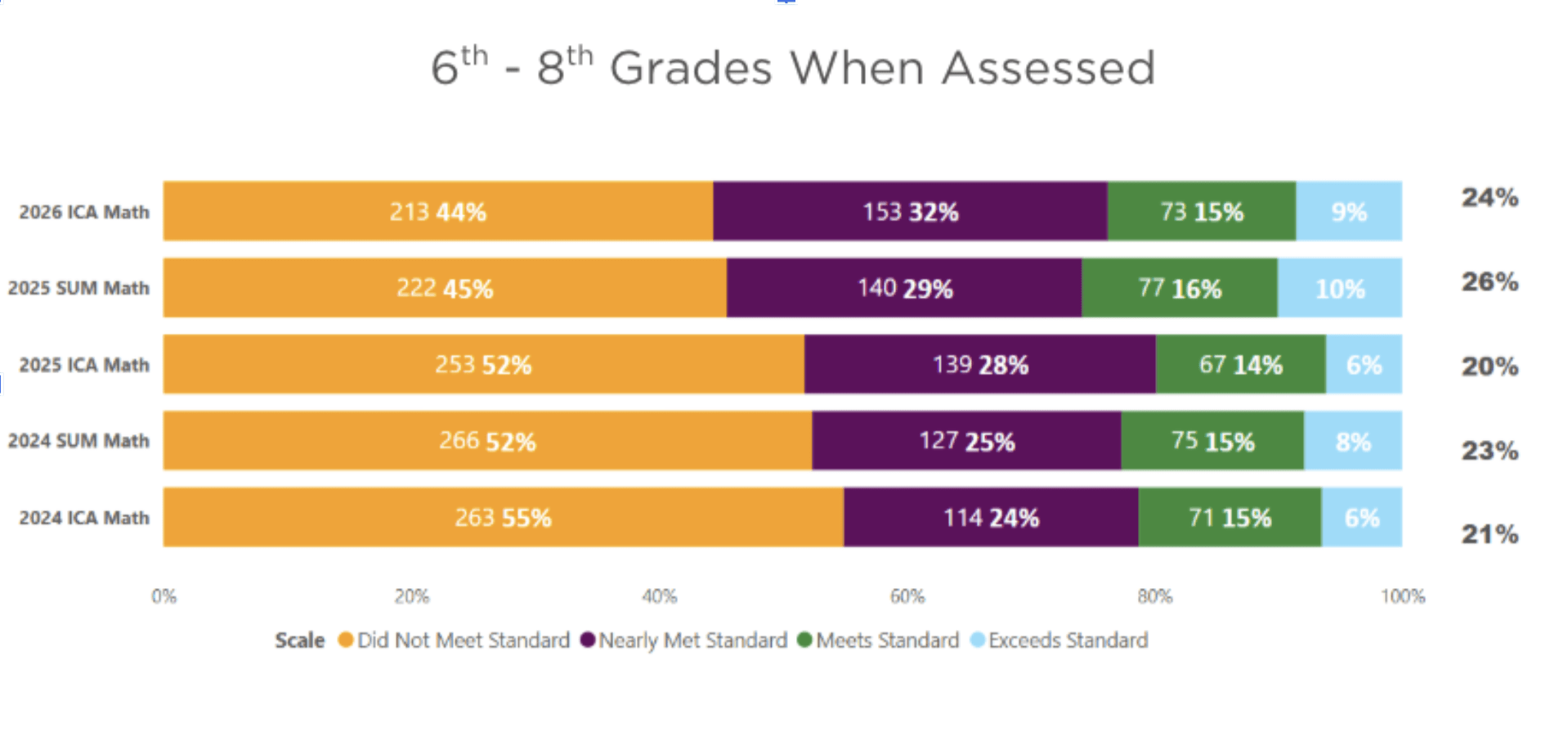
Summative data shows progress on a cohort basis, and the Grow team is working hard to continue these trends.
Learn more / take action
To read more about the use of practical measures in improvement efforts, please read this article from The Learning Professional.
Register to attend Learning Forward’s Curriculum-Based Professional Learning Symposium, Bakersfield, CA April 29-30, 2026. The symposium is designed for education leaders and teams who have responsibility for curriculum and instruction in their schools and districts.