

Research solidly supports the idea that curriculum has a direct impact on student engagement and learning. On their own, high-quality instructional materials are not enough; to make a positive impact on their students, teachers must engage in ongoing support to learn how to use high-quality curricula and implement them with integrity. Curriculum-based professional learning (CBPL) is an essential component of improving teacher practice and advancing student learning.
For more than 10 years, Learning Forward has been a leader in building, facilitating, and implementing networks to drive improvement in education. Learning Forward’s first CBPL Network launched in 2023. In just one year, participating network schools and districts saw strong growth in teacher practice and student outcomes. Additionally, there was an increase in the integrity of curriculum implementation, increased student engagement, and improved student outcomes over time.
In summer 2025, Learning Forward launched the CalTex Network focused on effectively using CBPL to support the implementation of middle school mathematics curricula for selected middle schools in the Central Vally of California and in Texas. Leveraging the specifics of CBPL and strategies of continuous improvement prepares teams to test and measure classroom changes that improve the implementation of Illustrative Mathematics in California and Bluebonnet Learning mathematics in Texas. By employing specific strategies to focus professional learning on effective use of the math curriculum, this work is expected to positively affect teaching and learning for all middle school students.
According to Michelle Bowman, Learning Forward senior vice president, Networks & Continuous Improvement, teachers and leaders are too often left to navigate curriculum implementation without effective support and adequate resources, including time – and they struggle with implementation or take it upon themselves to make alterations.
Learning Forward’s current Curriculum-Based Professional Learning Network leverages learning teams to design and implement professional learning interventions using disciplined inquiry and problem-solving. The Network is grounded in two premises, Bowman said. First, curriculum launch or implementation without tightly aligned professional learning can lead to content gaps from one grade to the next, lessons targeted at the wrong level, and ineffective differentiated support for students. Second, to effectively implement a high-quality instructional model with integrity, educators need a supportive, coherent professional learning system that is aligned with Standards for Professional Learning (Learning Forward 2025).
CBPL: What it is, what it isn’t
Because it is not uncommon for educators to not have a clear definition or common understanding about how curriculum-based professional learning differs from content-focused professional learning or other types of teacher training, Bowman offers defining characteristics of what curriculum-based professional learning does and doesn’t do when she is presenting the topic.
Curriculum-based professional learning does:
- Focus on the integrity of implementation of high-quality instructional materials
- Engage educators in the same kind of inquiry-based learning they are expected to provide for their students – for example, by working through curriculum lessons and engaging in continuous improvement cycles to examine their strategies and test improvement ideas
- Use ongoing and active learning experiences that prompt teachers to change their instructional practices, expand their content knowledge, and challenge their beliefs
Curriculum-based professional learning does not:
- Consist solely of sessions focused on orientation to the curriculum or instructional materials
- Focus on content outside of or disconnected from the curriculum and instructional materials
- Rely on siloed or disconnected learning sessions with no progression of skills and lessons over time
- Consist of training sessions focused solely on building teacher content knowledge
Key resources
Learning Forward’s Curriculum-Based Professional Learning Network programming is anchored in three foundational resources:
Learning Forward’s Standards for Professional Learning. Standards provide the best available research and guidance for educators to build a system of support for driving improvement and sustaining change, and describe the content, processes, and conditions of high-quality professional learning that ensures each educator and each student engages in high-quality professional learning. The CBPL Network especially embodies the The Curriculum, Assessment, and Instruction standard, Implementation standard, and Culture of Collaborative Inquiry standard.
Carnegie Corporation of New York’s The Elements: Transforming Teaching Through Curriculum-Based Professional Learning.The Elements report indentifies a core set of actions, approaches, and enabling conditions that effective schools and systems have put in place to reinforce and amplify the power of high-quality curriculum and skillful teaching. It calls on school and system leaders, teachers and coaches, and all specialists in professional learning to transform teaching and learning through the elements and essentials of curriculum-based professional learning.
Columbia Center for Public Research and Leadership’s Curriculum-Based Professional Learning: The State of the Field.This 2022 report identifies the strengths of curriculum-based professional learning and examines its opportunities to grow, scale and strengthen.
Foundational concepts
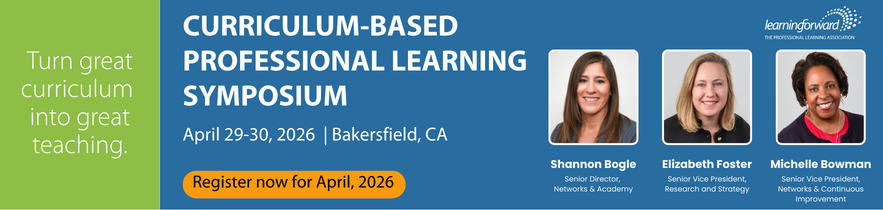
Bowman, Elizabeth Foster, and Shannon Bogle, and colleagues are finalizing the programming for a two-day Curriculum-Based Professional Learning Symposium April 28-29, in Bakersfield, California, during which they will home in on three key foundational concepts of curriculum-based professional learning for participating education leaders and teams:
- Curriculum-based professional learning drives the effective use of high-quality instructional materials which impact student engagement, achievement, and access to future opportunities.
- Experiencing high-quality instructional materials through curriculum-based professional learning as a learner shapes educator practice.
- Implementing new curriculum and instructional materials requires supporting educators to understand, engage in, and manage the change process.
According to Bowman, “Teachers are being asked to teach in ways they have never been taught. CBPL helps teachers know how to take advantage of everything high-quality, standards-aligned curriculum and instructional materials has to offer so that students’ access and opportunity to learn are maximized. It turns high-quality instructional materials from something teachers have into something students actually experience.”
Learn more
Curriculum-Based Professional Learning Network web page
Reflect on your Curriculum Based Professional Learning using our CBPL Tool.
Coming up
Curriculum-Based Professional Learning Symposium, Bakersfield, CA April 29-30, 2026, is designed for education leaders and teams who have responsibility for curriculum and instruction in their schools and districts.