

Fostering school improvement through high-quality professional learning is always challenging for education leaders, but recently, they have been called on to address their numerous improvement challenges while funding is even more limited than in previous years.
“Out of the box” or “from the catalog” programs may offer strategies or ideas that sound good, but they often lack grounding in the district’s existing improvement efforts. This lack of alignment typically leads to little implementation or impact and for which the program garners no meaningful support.
Education leaders need professional learning that adapts to existing structures and their staff’s strengths.
According to Sharron Helmke, Learning Forward senior vice president of professional services, “In Learning Forward’s work with districts and systems, we are not going to suggest they start over or change their models. That wastes past investments and overwhelms staff. We’re going to help them inventory what’s already in place, crystallize their vision for improvement, and consider how they want to move forward to optimize impact.”
Four places to customize professional learning
Effectively customized professional learning programs can cost less than ”out of the box” fixed priced programs that aren’t place-specific. Customization saves time because the professional learning programs are targeted to immediate and relevant learning needs. Customization also allows work to be specified and sequenced in such a way that it becomes more budget-friendly, even during lean funding years.
Helmke highlighted four areas of customization Learning Forward provides that leaders might not know or think to ask about in contracting for professional learning services:
- Start with what’s already working / showing promise
- Create within-district scalability and sustainability
- Tailor the level of support provided to best complement existing expertise / experience
- Design professional learning to accommodate budgets and timelines
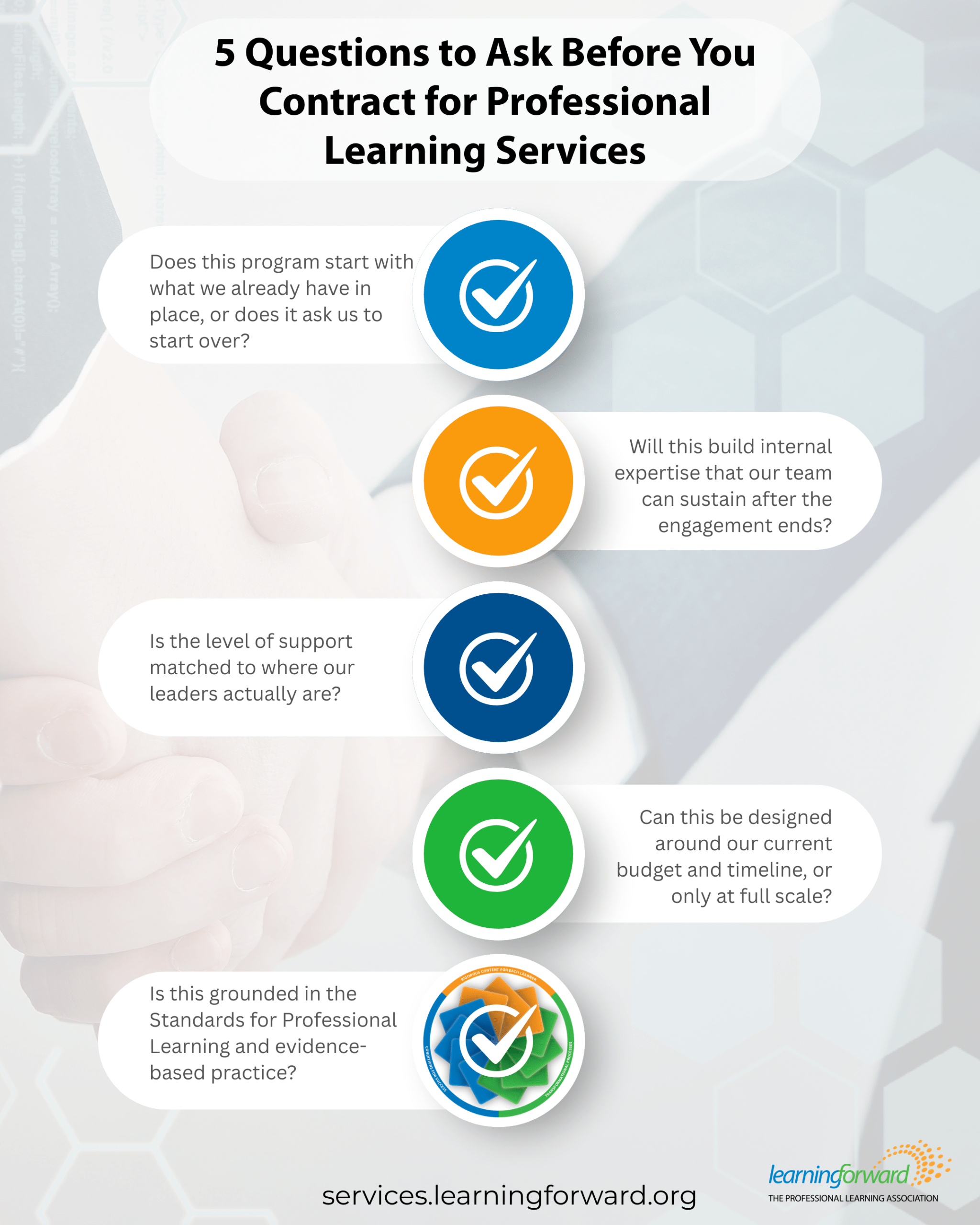
Start with what’s already working or showing promise. Customize professional learning strategies around what’s already in the district that is working well. “We talk with professional learning leaders to identify a logical starting place for the change they want to see; we look at the system, campus, and individual levels;” Helmke said, “and we consider existing strategic goals, initiatives, and structures.” In terms of customization, “our work with them starts where they are, not where a predesigned program says they should be.”
Create within-district scalability and sustainability. Fostering in-district expertise to support sustainable scaling and improvement is a hallmark of Learning Forward’s approach. According to Helmke, Learning Forward’s work is not just bringing learning sessions to the client’s organization, but also includes specialized support for leaders in understanding how to keep the growth going long after the services contract has ended. This includes how to troubleshoot implementation efforts as the program is scaled to accommodate differences between campuses, teams, grade, or content areas.
Tailor the level of support provided to best complement the existing expertise and experience of program leaders. “The most effective professional learning programs,” said Helmke, “complement leaders’ existing knowledge and leadership styles rather than substituting the consultant’s expertise for theirs.
“If the work we’re talking about with a district is totally new to them, then most likely they need us to come in and facilitate – we take responsibility for all the planning and facilitating while they’re the learners,” Helmke said. “If they have experience and a comfort level facilitating and leading the learning, then we’re likely going to enter into a collaborative stance. We will have meetings with the team where we jointly plan each session of the work for the larger group. So, we’re still taking the lead as needed, but they have a voice in the writing and the planning because they have expertise in this area. If they have strong in-house expertise, they might just need us as an outside voice to coach into district leaders’ thinking during planning and assessment of their professional learning to make sure they’re considering all relevant factors and questioning their own assumptions about potential barriers.”
By adapting to the existing expertise of program leaders, Learning Forward supports their ability to create and sustain learning and improvement while ensuring that evidence-based practices and the Standards for Professional Learning are at the heart of all program efforts.
Design professional learning to accommodate budgets and timelines. Leaders need to be clear about how much they have available to spend for outside professional learning services and the timeline in which they need the services to be delivered to have impact. Helmke underscored that districts can start their important work even with a relatively small amount allocated. “We’re going to help them find a place to start with the funds they have. It helps if I lay out what the ‘north star’ version would look like and then recommend where they can get started based on what they have to spend and what they need to accomplish.” Arriving at a final scope of work for services is the result of conversations and revisions between Learning Forward and the organizational leaders.
In terms of doing more with less, “they don’t have to think they can’t get started improving student math scores, for example, because they can’t afford a new curriculum,” Helmke said. “It’s a question of saying, where can we start? What steps can we take right now? By considering evidence-based practices and the Standards for Professional Learning, we can help them assess their current state and start making positive changes through professional learning.”
Making the most of professional learning resources
Choosing customized professional learning allows a leader to make effective and intentional strategic choices about what and how professional learning will be offered to their staff. In working with external partners, “leaders should insist on services that are aligned with established goals, part of a long-term strategy, customized, evidence based, and capacity building,” Helmke suggested. “These quality factors set the groundwork for a strong district-provider partnership that will really make a difference in student achievement.”
Learn more
Learning Forward has years of experience in customizing professional learning programs for state, district, and local educational organizations. Contact us to talk through this and we can write a scope of work that fits your needs and can be implemented and scaled.
Learning Forward Custom Education Consulting
services.learningforward.org/custom-education-consulting
Free tool: 5 Questions to Ask Before You Contract for Professional Learning Services