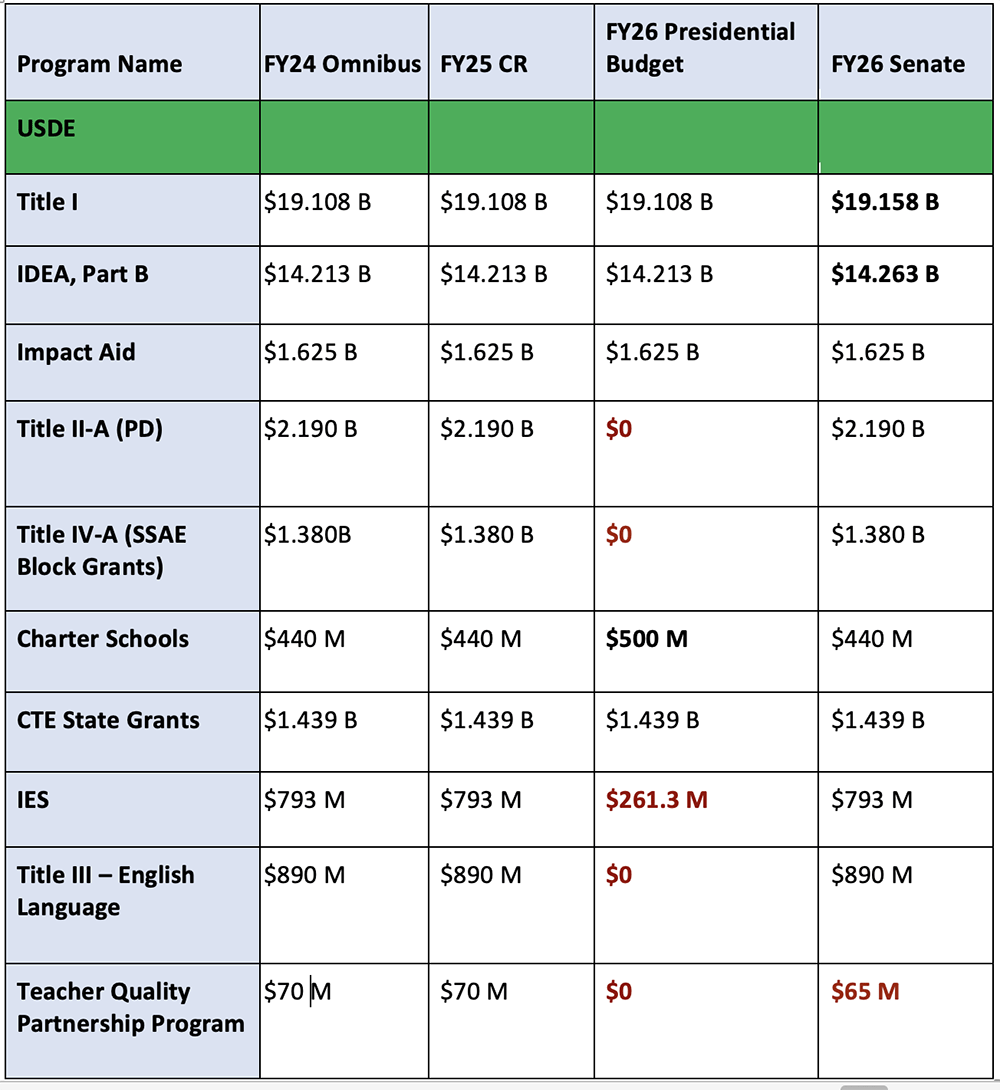


On July 31st, the Senate Appropriations Committee debated and approved its version of the fiscal year 2026 Labor HHS Education Appropriations bill, clearing them for floor action after Congress’ August recess. While this bill made a few significant cuts, including slashing $40 million from the Department of Education’s Program Administration budget, overall most education programs received near-level or level funding over last year, including Title II-A, Supporting Effective Instruction State Grants. Title I-A and IDEA even received increases.
The bill does not include any language to codify the President’s proposals to create a massive K-12 block grant or alter Title I and IDEA. It also continues to fund many of the programs that the President’s budget proposed for elimination and continues funding for the Institute for Educational Sciences, the Department’s research arm which has seen all of its staff terminated. The House’s version, which has not been introduced or marked up, will likely look substantially different. This will make it extremely difficult to negotiate a final funding deal.
The Senate’s Labor HHS Education bill incorporates new language that is designed to protect the Department of Education from dismantling, notably language that requires “the Department of Education maintain the staff necessary to ensure it carries out its statutory responsibilities, including carrying out programs and activities funded in this bill in a timely manner.” It also prohibits the Department from transferring “significant responsibilities related to carrying out Title I, Part A of the ESEA or parts B and C of the IDEA from the Department of Education to another department or agency.” It is worth noting that the bill does not bar transferring all responsibilities from these programs to another agency and does not mention any other Departmental programs or services, including Career and Technical Education, which the Department plans to shift to the Department of Labor. Responding to the recent funding delay crisis, the bill also includes new requirements for the Department of Education to make formula grants available to states and districts on time.
Title II-A, the $2.19 billion professional development formula grant, and Title IV-A, the $1.38 billion flexible block grant, both received level funding from the Committee. The President’s FY26 budget had proposed to consolidate these two programs with 16 other K-12 programs into a single block grant, and then slash overall funding by 70%. Most recently, FY25 funding allocations for both programs had been held up by the Department of Education and the Office of Management and Budget. For Title IV-A, the Committee “directs the Department to obtain and examine data on State and local expenditures, outlined by specific authorized activities, and provide information about how LEAs plan to evaluate the effectiveness of their activities.”
Below is a breakdown of key K-12 program funding levels